

September 8, 2026
- Gate Operators
- Inground Motors
- Swing Gates
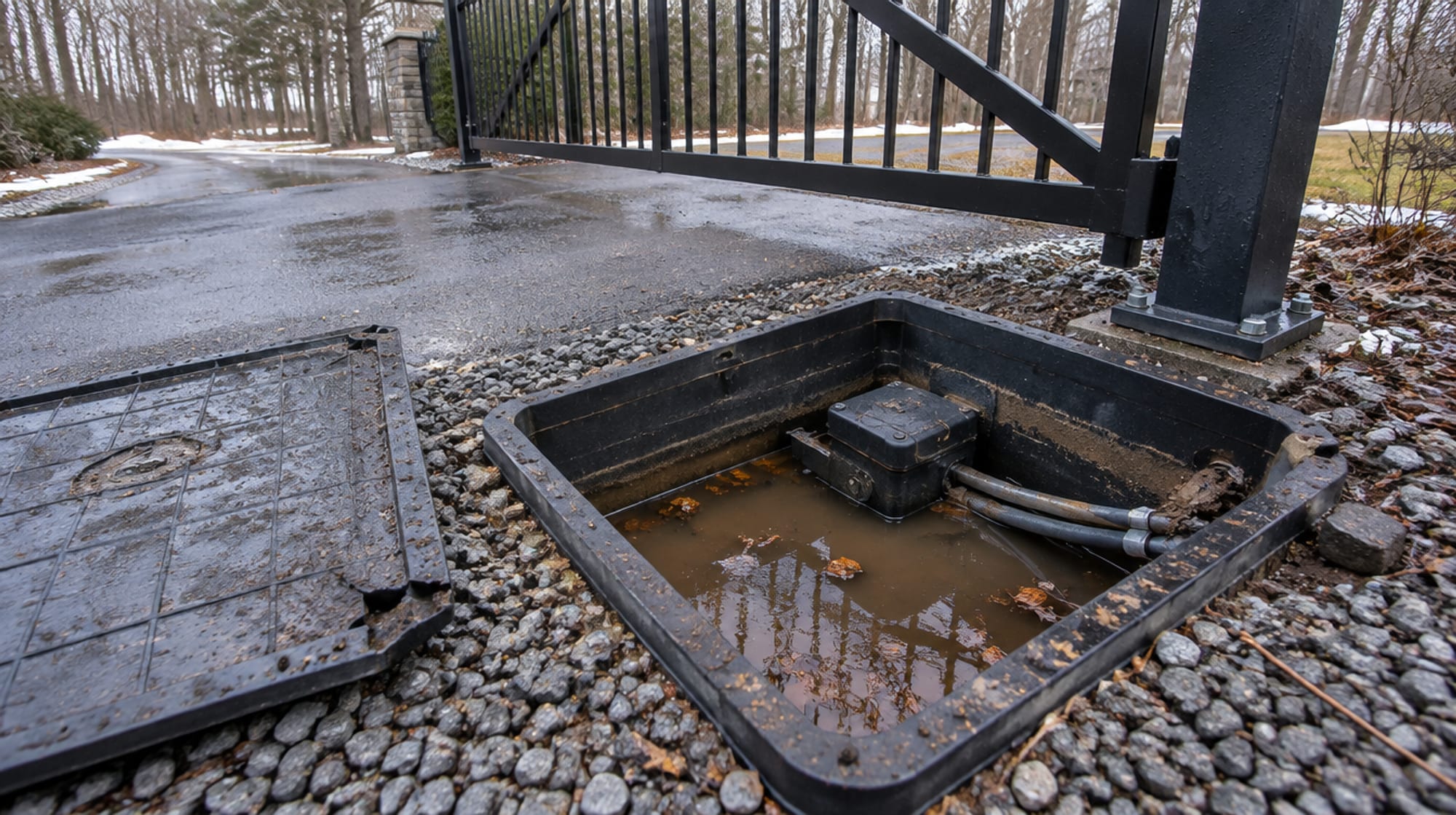
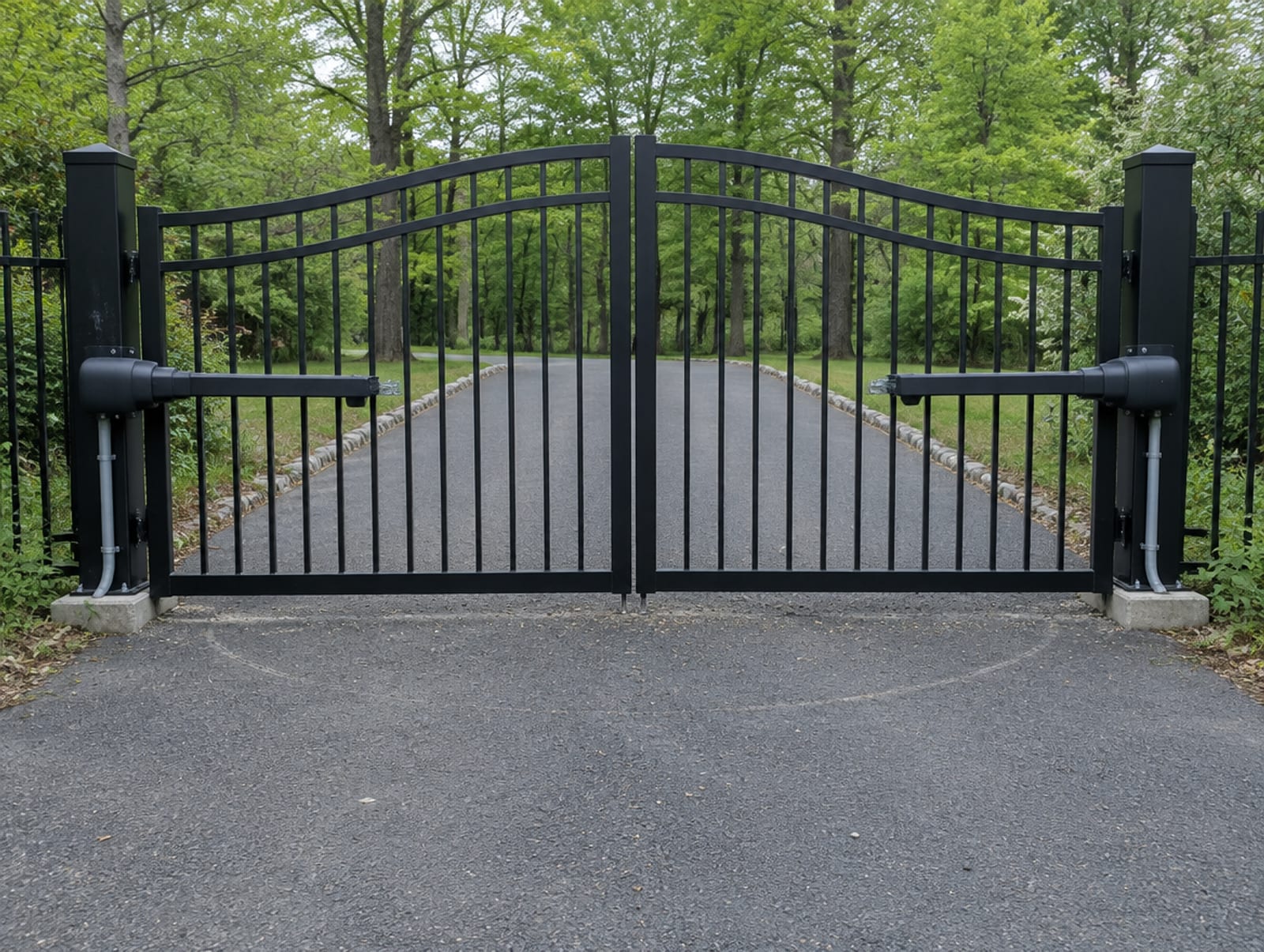
Both kinds of swing gate operator have to meet the same UL 325 entrapment rules, so safety does not decide between them. Drainage, access and price do. An inground operator sits in a foundation box under the gate and needs water to drain out of it. An above-ground arm bolts to the post and the gate, where you can see it and reach it from above grade.
Key Takeaways
Same safety rules
UL 325 Table 32.2 asks for two independent entrapment-protection means in each direction of travel where an entrapment zone exists, for both kinds
Inground needs a drain
the FAAC 770N manual calls for a rainwater-drain tube and a foundation box fixed in concrete, about 17 by 12 by 8½ inches (430 by 307.5 by 214 mm)
Above-ground limits
the LiftMaster LA400 handles gates up to 16 feet and 550 pounds, and the FAAC 390 handles leaves up to 3 meters
Published installed prices
one residential cost guide lists inground rams at $1,500 to $3,500 per side, and above-ground arm hardware at $250 to $2,000 depending on tier
Service terms differ
FAAC calls for inspection every six months and carries a 24-month warranty from the invoice date, and LiftMaster lists 2 years on the LA400 and 3 on the RSW12UL
What each one needs from the site
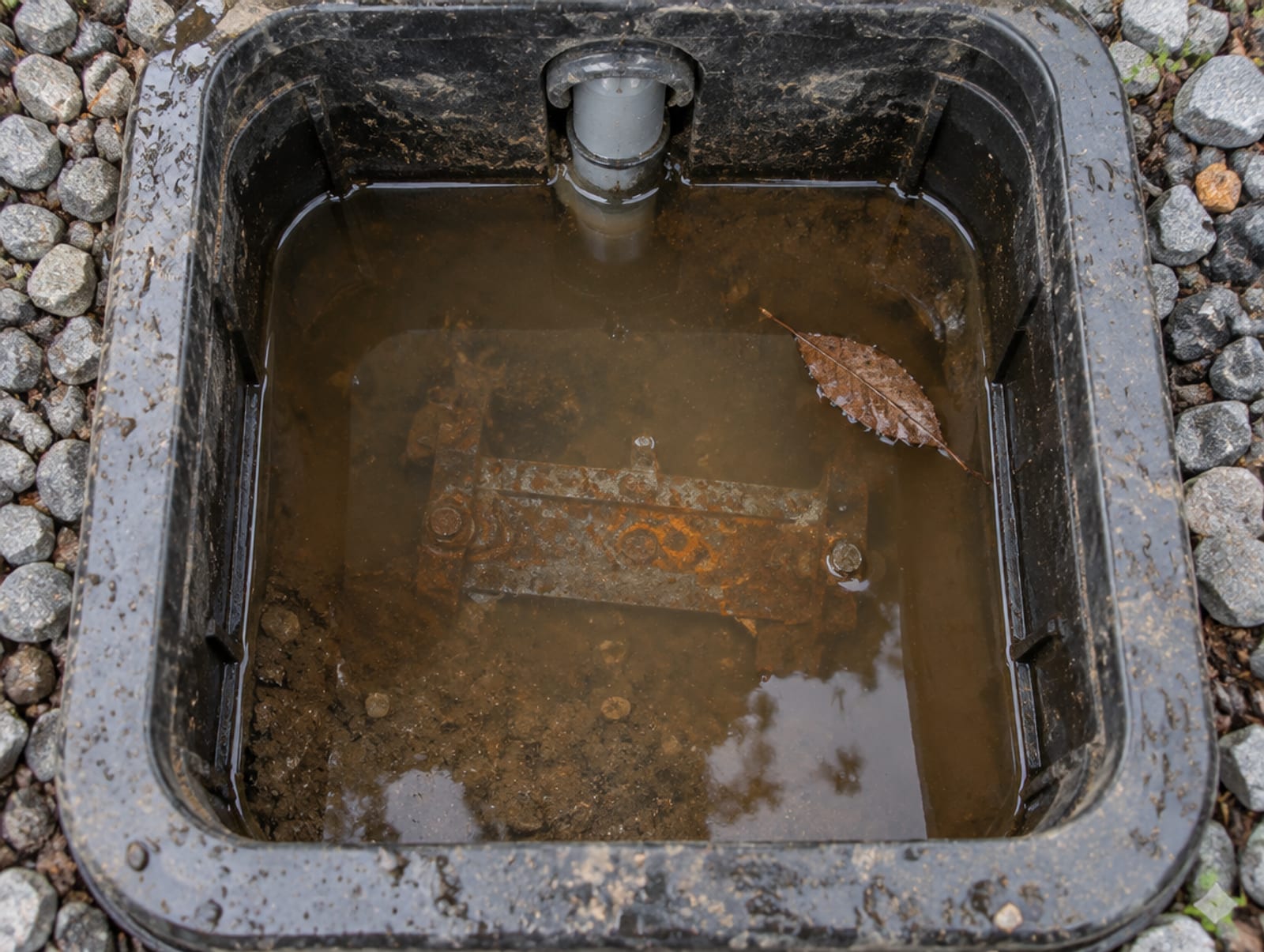
Inground. The FAAC 770N installation manual describes a foundation box about 430 by 307.5 by 214 millimeters, roughly 17 by 12 by 8½ inches. The installer digs a hole to the manual's figure and adjusts it for the ground, positions the box, runs cable conduit, installs a rainwater-drain tube and sets the box flat in concrete, fixed in place. The operator itself goes inside, and the cover is screwed down afterward. The 770N is rated IP67 and operates from -20°C to +55°C, which is about -4°F to +131°F. IP67 does not guarantee that poor site drainage or standing water will not cause damage, and the manual's requirement is positive drainage out of the box. For the excavation dimensions on your gate, the base under the box and the frost-related details, confirm them with the installer against the exact FAAC figure for the revision being installed, for your soil and drainage.
Leaf limits for the 770N are 500 kg (about 1,100 pounds) and 2 meters (about 6½ feet) of leaf width, or 3.5 meters (about 11½ feet) with an electric lock. The Rev. B manual gives maximum leaf length as 3.5 meters at 110 degrees, 3 meters with the 180-degree kit and 2.5 meters with the 140-degree kit.
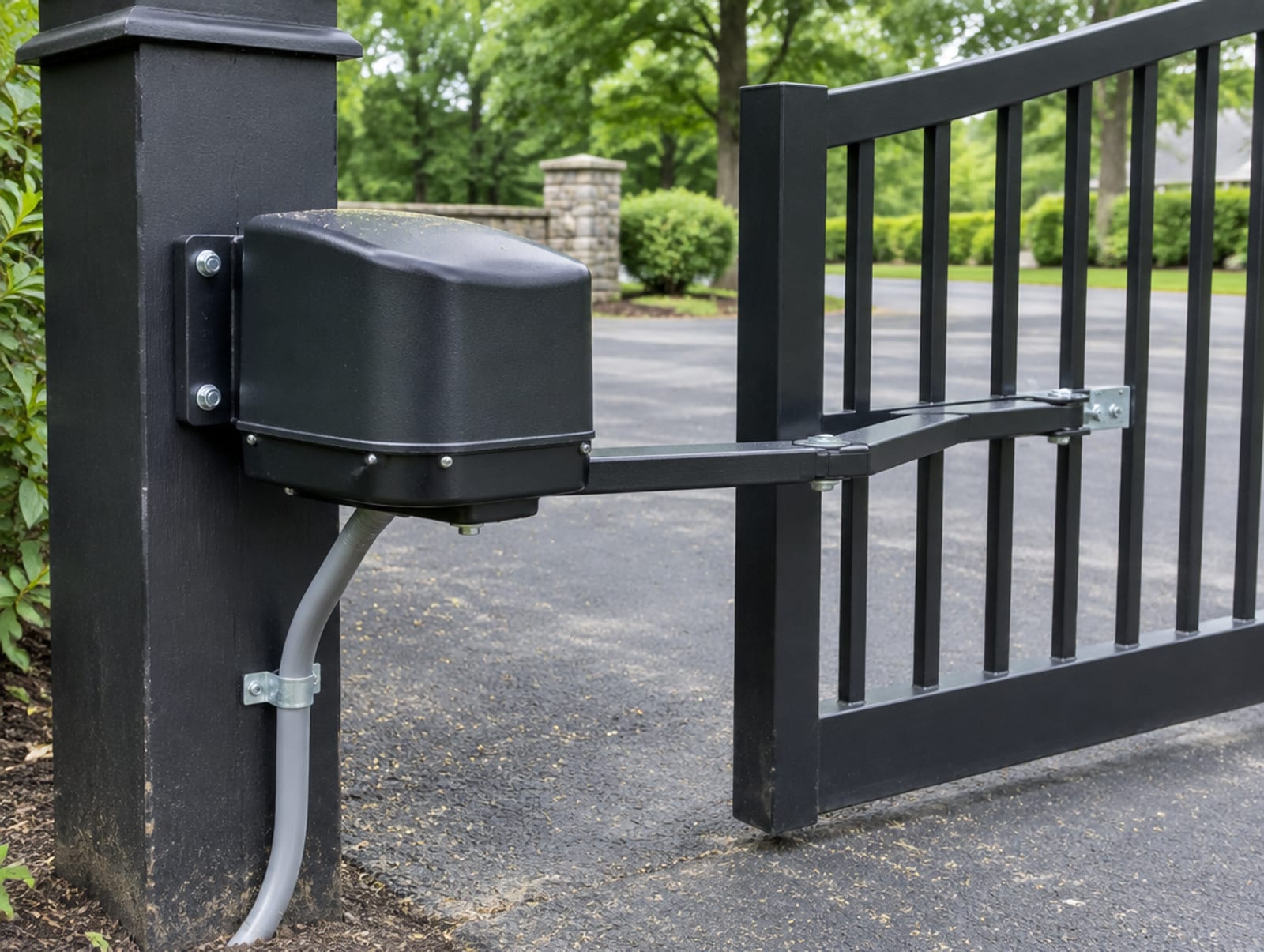
Above-ground. An arm operator mounts where the post and the gate meet, so it depends on solid mounting and correct geometry.
- FAAC 390: the base plate is secured to the pilaster with Ø10 screws and suitable expansion plugs and must be perfectly horizontal. The articulated arm connects the operator shaft to a front coupling on the leaf, and the coupling may be welded or screwed on. Arm and coupling must be horizontal, and the maximum leaf length is 3 meters
- LiftMaster LA400: the post bracket mounts with 3/8-inch bolts and the gate bracket to a cross member with 5/16-inch bolts. The post bracket lines up with a cross member near the vertical center of the post, the gate-bracket reference sits 7-3/4 inches from the hinge center in the standard pull-to-open layout, and the gate may open no farther than 100 degrees during that adjustment. The operator must be level, and the limits are 16 feet and 550 pounds
Gate size limits stated in each manufacturer's manual
Mounting: Inground
Stated limits: 500 kg (about 1,100 pounds); leaf width 2 meters (about 6½ feet), or 3.5 meters (about 11½ feet) with an electric lock
Tap a row to open it.
The safety rules are the same
UL 325, Seventh Edition, Section 32, governs electric gate operators and their external entrapment-protection devices, residential ones included, since its Class I covers garages and parking areas associated with one to four single-family homes. For horizontal swing operators, Table 32.2 requires two independent entrapment-protection means in each direction of travel when an entrapment zone exists. Where there is no zone in one direction, one means is required in that direction. The permitted types are:
- Type A: inherent protection in the operator
- Type B1: monitored non-contact protection, such as photoelectric sensors
- Type B2: monitored contact protection, such as edge sensors
- Type C: inherent force limiting, an adjustable clutch or pressure relief
- Type D: continuous-pressure control
Section 32.1.8 requires the operator to monitor external devices at least once in each open and close cycle, and Section 32.1.10 prevents simple field modifications from defeating that monitoring. The operator's location in or on the ground does not change the category. The devices have to cover every identified entrapment zone, including the ones the swing arc creates, and LiftMaster's gate safety checklist also covers the ASTM F2200 geometry checks, such as the pivot-to-column distance and protection where an open gate approaches a wall or column.
Service access and upkeep
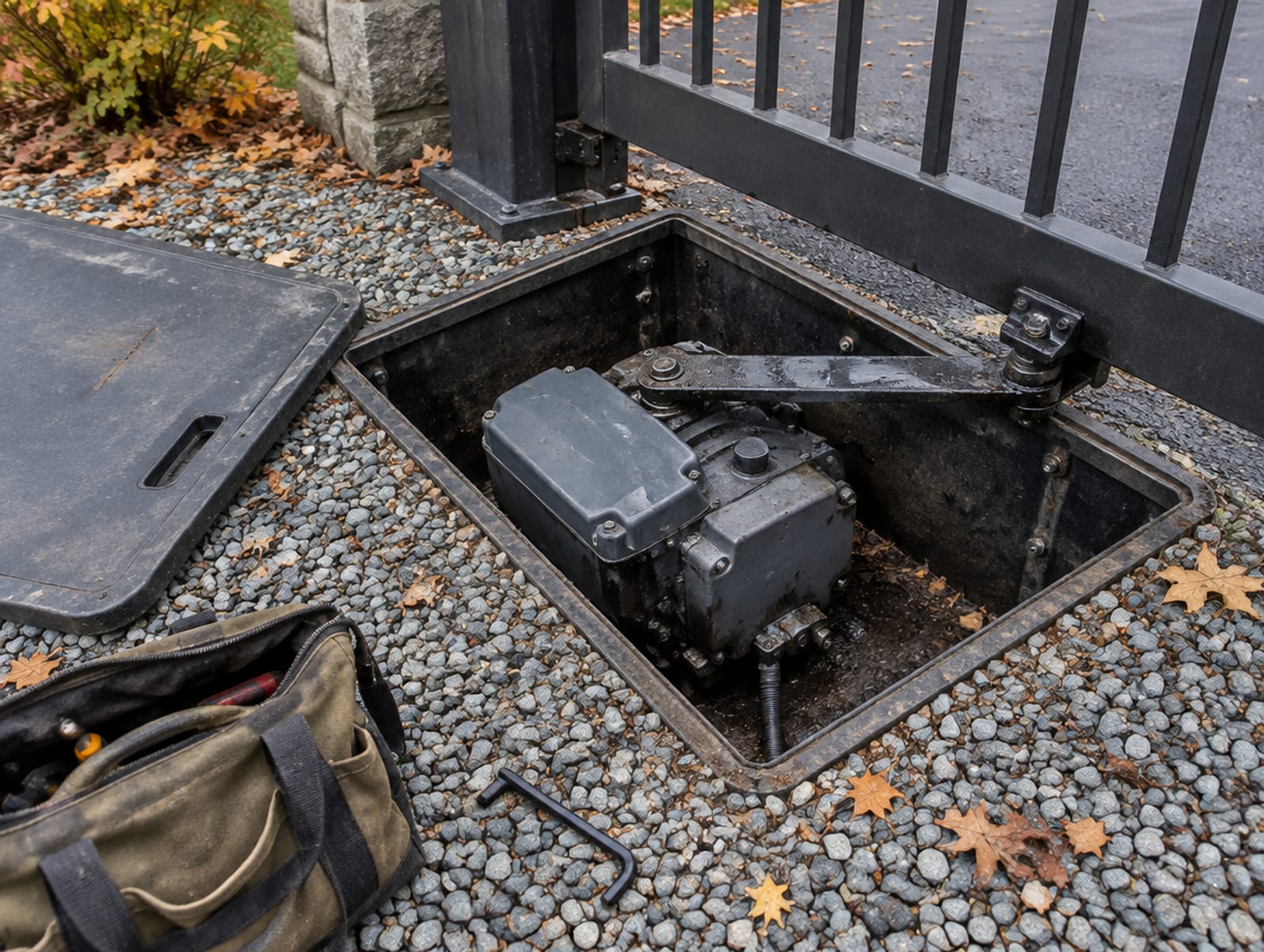
The FAAC 770N is reached by removing the foundation-box cover, and FAAC states that access to the operator is possible without removing the gate leaf. The manual says to grease the rotation pin and ball and the lever pins, never the release device, and calls for an inspection every six months. Repairs go to qualified FAAC personnel or service centers.
The LA400 sits above grade between the post and gate brackets, so the motor and arm are reachable from above. Its manual requires that all maintenance be done by a LiftMaster professional. The maintenance table calls for monthly checks of the external entrapment protection, warning signs, manual disconnect, gate, accessories, electrical connections, frame bolts and the total unit, with complete check-outs at six and 12 months.
Ask any installer whether the service plan covers cover removal, motor removal, excavation, drainage correction and restoration, because those jobs are different for an operator in the ground.
Warranty terms
- FAAC 770 and related FAAC International language: 24 months from the invoice date, covering defects in materials and workmanship under normal intended use. It excludes alteration or repair without written consent, misuse, negligence, accident, operation contrary to instructions or beyond the specifications, and maintenance parts. The U.S. warranty extends to wholesale customers through normal channels, so consumers ask the selling dealer about any dealer warranty
- LiftMaster RSW12UL: 3 years on the operator
- LiftMaster LA400: a 2-year limited warranty
LiftMaster's general warranty excludes non-defect damage, improper installation, operation or care, abuse, misuse, failure to provide reasonable maintenance, unauthorized repairs, alterations, consumables and reinstallation labor. Neither company's warranty language names water damage, vandalism or vehicle impact in those words, and each could fall under an excluded category depending on the facts. Get the exact warranty for the model you are buying and ask the dealer, in writing, how those three are handled.
What each costs
One published residential gate-cost guide, which does not name a region, lists typical underground rams from FAAC and BFT at $1,500 to $3,500 per side installed. It lists above-ground swing-arm hardware at $250 to $450 for entry-level units, $400 to $800 for mid-tier units and $900 to $2,000 for commercial-grade residential units. A FAAC catalog lists the 770N 230V at 449 euros, which is a product price rather than an installed price, and a supplier price list dated January 1, 2025 lists above-ground swing operators from £346.50 to £1,113 and an underground R18FAST at £909. Those last two are equipment prices in other currencies, not Hudson Valley quotes, so they do not convert into a local comparison.
For a Hudson Valley job, ask for separate lines for the operator, foundation box, excavation, drainage, conduit, concrete, wiring, safety devices, labor and restoration. Compare duty cycle as well. FAAC lists the 770N 24V for continuous use and the 770N 230V for S3 30% use, and it calls for six-month inspections. Compare those against the warranty, parts availability and the installer's written service terms.
Check yourself
1. How many independent entrapment-protection means does UL 325 Table 32.2 ask for in each direction of travel where an entrapment zone exists?
2. What does the FAAC 770N manual call for to get water out of the foundation box?
3. Which describes the LiftMaster LA400 limits?
4. How often does FAAC call for an inspection of the 770N?
Frequently Asked Questions
Q: Is an inground operator safer than an above-ground arm? A: No. UL 325 Table 32.2 applies to both, and the protection types and monitoring rules are identical. What differs is how each is mounted and reached.
Q: Why does an inground box need a drain? A: The FAAC 770N manual calls for a rainwater-drain tube. The lid is not sealed, and the box needs a path for water to leave. IP67 protection does not cover standing water from poor site drainage.
Q: Can an inground operator be serviced without removing the gate? A: FAAC states access is possible without removing the leaf. The cover comes off, and the manual calls for inspection every six months.
Q: How heavy a gate will an above-ground arm move? A: The LiftMaster LA400 is rated for gates up to 16 feet wide and 550 pounds. The FAAC 390 lists a 3-meter maximum leaf and gives no leaf-weight figure, so ask the dealer.
Q: Which one costs less? A: One published guide lists $250 to $2,000 for above-ground arm hardware and $1,500 to $3,500 per side for underground rams installed. The scopes differ, so a quote with every line itemized is the fair comparison.
Both operators do the same job under the same safety standard. The choice is whether you want the mechanism hidden in the ground behind a drainage requirement or visible on the post where it can be reached. A written quote that itemizes the box, the drainage and the service terms makes the difference concrete.
At Portillo Fences and Gates, we install inground motors and arm operators as part of automatic gate work across Putnam, Westchester, Dutchess, Orange, Ulster and Rockland Counties. We look at the post, the swing arc and the drainage on your property before recommending one. Contact us for a free estimate, or call (845) 282-3336.