

August 30, 2026
- Automatic Gates
- Gate Safety
- UL 325
A driveway gate at a one- to four-family home falls under UL 325 as a Class I residential vehicular gate operator, and in New York the state code makes that standard binding. Section BH103.2 of the 2025 Residential Code of New York State says a vehicular gate opener, where one is provided, must be listed in accordance with UL 325.
That covers the operator. The gate it moves is covered by a second standard, ASTM F2200, and the two together decide what safety devices go on the gate.
Key Takeaways
Class I covers a home
UL 325 defines a residential vehicular gate operator as one intended for a home of one to four single-family dwellings, or an associated garage or parking area
Two independent protections, in most cases
horizontal slide and vertical pivot gates need 2 in each direction; swing gates need 2 unless there is no entrapment zone; vertical lift gates need 1
The same device type cannot count twice
UL 325 Table 32.2 requires the two means to be independent
New York adopts both standards
RCNYS Appendix BH, Sections BH103.1 and BH103.2, and Building Code Sections 3110.2 and 3110.3
Older operators
a retrofit may be possible where the operator has monitored inputs and the manufacturer lists the device as compatible
Which operators UL 325 covers
ANSI/CAN/UL 325, Edition 7, revised September 15, 2025, covers electric operators for gates and other opening and closing appliances rated 600 volts or less, complete gate assemblies containing electric operators, and external entrapment protection accessories. It sorts vehicular gate operators into four classes:
- Class I, residential: a home of one to four single-family dwellings, or an associated garage or parking area
- Class II, commercial or general access: commercial locations, including multifamily housing with five or more units, hotels, garages, retail stores or buildings serving the general public
- Class III, industrial or limited access: factories, loading docks and locations not intended to serve the general public
- Class IV, restricted access: guarded industrial locations such as airport security areas
A Class I operator is still held to the standard. It must be listed to UL 325 and installed with the independent protection each entrapment zone requires. The class changes the setting the operator is intended for, not whether entrapment protection is needed.
How many devices, and what kind
Section 32 and Table 32.1 of the current seventh edition list which protection types each gate category may use:
Type A, B1, B2 or D
Tap a row to open it.
Table 32.2 sets the minimum number of independent means:
Opening direction: 2
Closing direction: 2
Tap a row to open it.
The types are:
- Type A: inherent entrapment protection built into the operator, such as obstruction detection and reversing
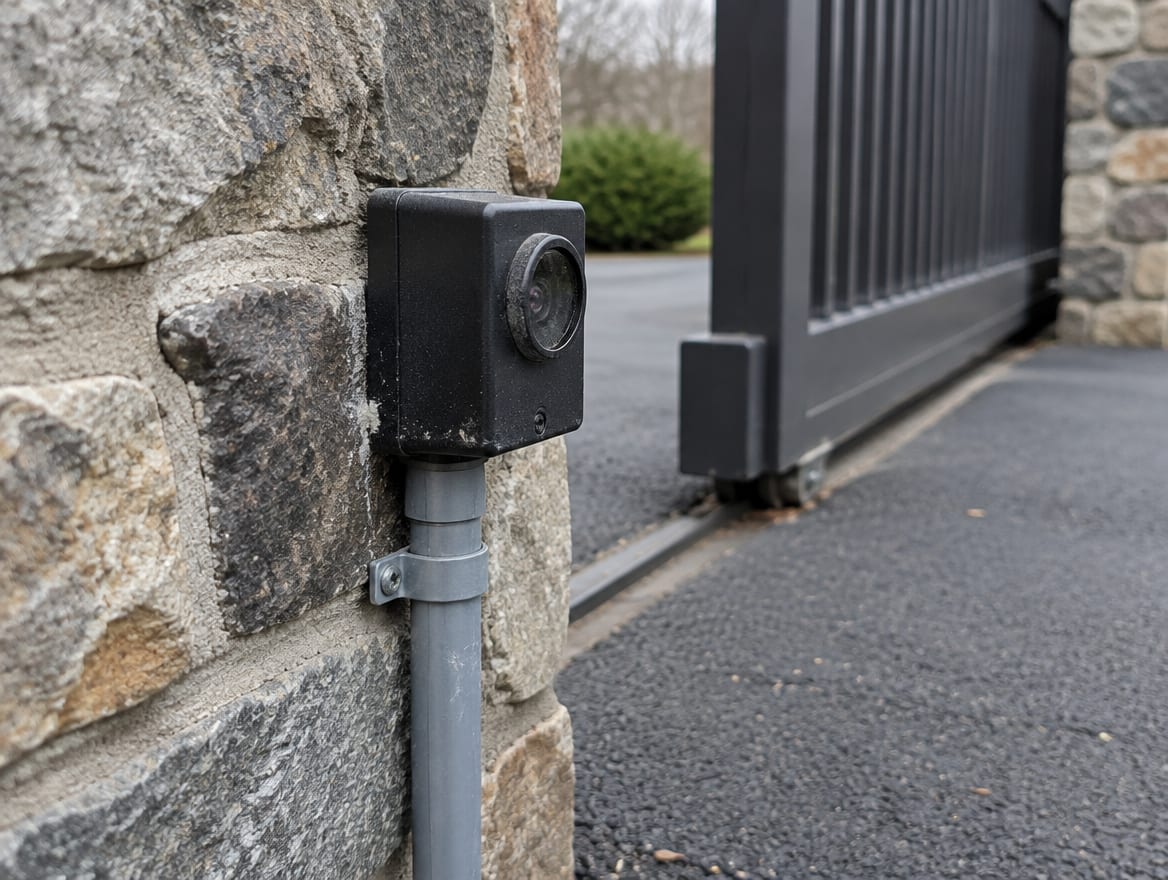
- Type B1: a non-contact sensor such as a photoelectric eye
- Type B2: a contact sensor such as a pressure-sensitive safety edge
- Type C: inherent force limiting, an adjustable clutch or a pressure-relief device, permitted on swing gates and barrier arms but not on horizontal slide gates
- Type D: a control that requires continuous pressure to keep the gate moving, within line of sight of the gate
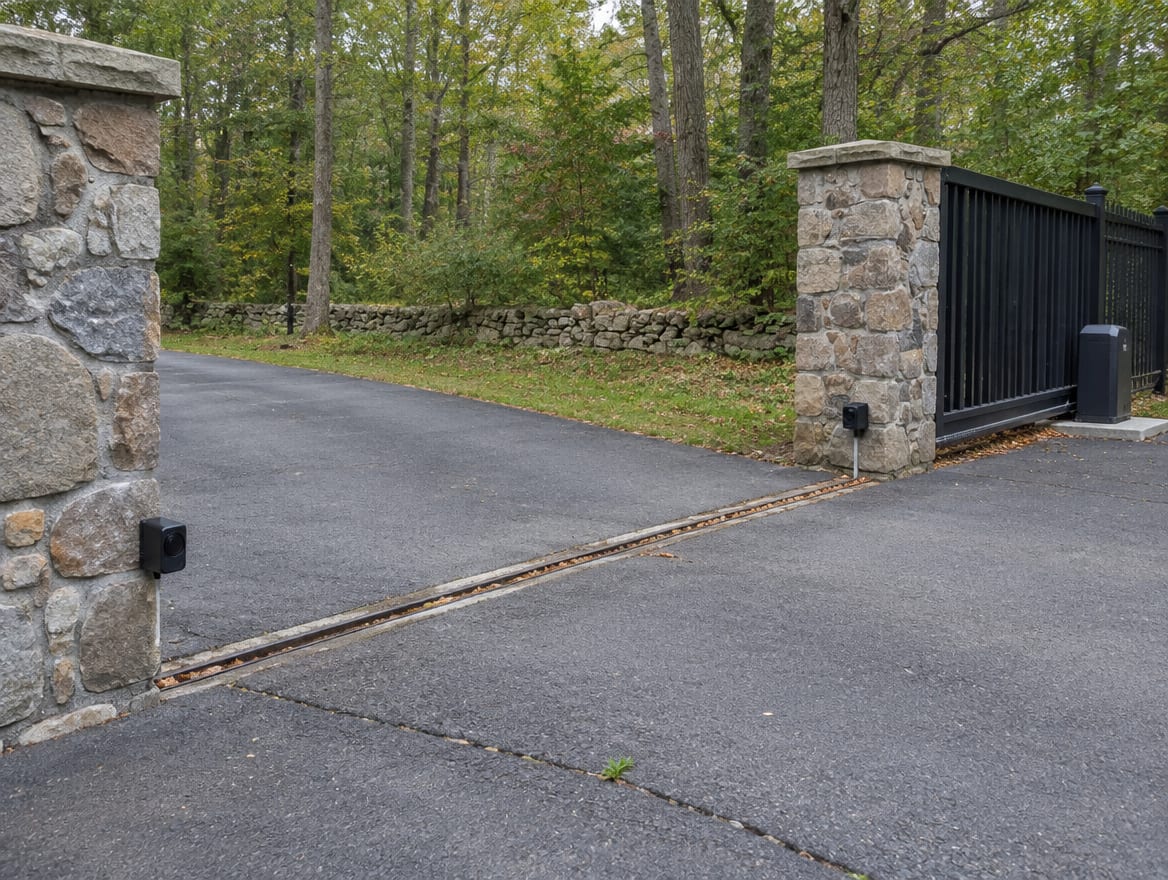
The same device type cannot serve as both independent means. On a sliding gate, that usually means the operator's own obstruction detection plus an external monitored photo eye or edge sensor, then a second independent device for each direction.
What manufacturers require
Manufacturer instructions show how this works on real equipment. The FAAC S800H ENC manual states that every entrapment zone defined by ASTM F2200 must have two independent protection devices, naming the operator's inherent protection and an external photocell or edge sensor, and that external devices are monitored for presence and correct operation. LiftMaster's SL1000ULC residential slide operator has built-in obstruction detection and reversing plus two monitored external devices, using photo eyes, resistive edges or both. LiftMaster's LA500PKGU documentation says only LiftMaster monitored photo eyes or edge sensors may be used with that operator to meet its 2016 UL 325 configuration.
LiftMaster also states that updates effective August 1, 2018 require two independent means in both the open and close directions on its slide gate operators, and that an installation without the required devices is not a UL 325 compliant system. The operator and its safety devices have to be tested and listed together.
The gate itself: ASTM F2200
UL 325 is about the operator. ASTM F2200 covers how the automated gate is built. Its Section 1.4 says automated vehicular gate systems shall comply with both standards. Some of its construction provisions:
- Horizontal slide gates: openings from the bottom to at least 6 feet above grade must be guarded or screened so a 2-1/4 inch sphere cannot pass through the gate or the adjacent fence area it covers
- Horizontal slide gates: the gap between the gate frame and the nearest fixed object, such as a support post, may not exceed 2-1/4 inches when the gate is fully open or fully closed
- Overhead pivot gates: openings must stop a 4-inch sphere, and the gap to the nearest fixed object may not exceed 2-1/4 inches
- All covered gates: designed so they cannot fall more than 45 degrees from vertical if detached from their supporting hardware
What New York requires
For one- and two-family dwellings, RCNYS Appendix BH controls automatic vehicular gates on the lot. Section BH101.1 states its scope, Section BH103.1 requires gates intended for automation to comply with ASTM F2200, and Section BH103.2 requires gate openers to be listed under UL 325. Table BH104.1 references ASTM F2200-20 and UL 325-2017, with revisions through February 2020.
The 2025 Building Code of New York State carries the same rule in Sections 3110.1 through 3110.3, and Section 406.2.1 sends automatic vehicular gates to Section 3110. The 2025 Uniform Code became fully effective December 31, 2025. The state code references an earlier edition of ASTM F2200 and UL 325 than the latest ones on sale, so ask for the edition and listing on your operator when the gate is quoted.
Permit and inspection practice for gate operators can differ by town, so confirm the permit, the inspection and the operator requirements with the building department that has jurisdiction over your address before work starts.
Older operators and adding protection
The federal rule on entrapment protection that the Consumer Product Safety Commission describes applies to residential garage door operators made on or after January 1, 1991. It is not an age rule for driveway gate operators.
For a driveway gate, LiftMaster says existing systems may lack current safety features and recommends evaluating them or bringing them to current requirements. Its documentation supports adding compatible monitored photo eyes or edge sensors where the operator has monitored inputs and the manufacturer lists the device as compatible. That is not true of every older operator, so the control board, wiring, entrapment zones and gate construction need to be looked at together.
Published prices for adding a sensor come from outside this region and are not Hudson Valley prices:
Location: California
Work: Photo eye installation
Published figure: $250 to $500
Tap a row to open it.
Ask for a written estimate that lists each device, the wiring and any permit or inspection fee as separate lines.
Check yourself
1. Which UL 325 class covers an operator at a home of one to four single-family dwellings?
2. How many independent means does UL 325 Table 32.2 require on a horizontal slide gate in each direction?
3. Which standard covers how the automated gate itself is built?
4. What is a Type B1 entrapment protection device?
Frequently Asked Questions
Q: Does UL 325 apply to a home driveway gate? A: Yes. A gate at a one- to four-family home is a Class I operator, and New York's RCNYS Section BH103.2 requires the opener to be listed under UL 325.
Q: How many safety devices does a sliding gate need? A: UL 325 Table 32.2 calls for 2 independent means in the opening direction and 2 in the closing direction on a horizontal slide gate.
Q: Is the operator's built-in obstruction sensing enough? A: It counts as one means, Type A. A second independent means is required, and the same type cannot serve as both.
Q: Can I add photo eyes to an old operator? A: Often, when the operator has monitored inputs and the manufacturer lists the device as compatible. The operator, control board and wiring have to be looked at first.
Q: Which standard covers the gate itself? A: ASTM F2200, which RCNYS Section BH103.1 requires for gates intended for automation.
Entrapment protection is the part of an automatic gate that does its work when nobody is watching. A quote that lists every device by type and location, for each direction of travel, shows what the gate will have on it.
At Portillo Fences and Gates, we install and repair automatic gates and access control across Putnam, Westchester, Dutchess, Orange, Ulster and Rockland Counties, with gate installation and gate repair for existing systems. We build each automated gate to UL 325 and ASTM F2200 and list the safety devices on the estimate. Contact us for a free estimate, or call (845) 282-3336.