

September 14, 2026
- Porch Railings
- Railings
- Building Code
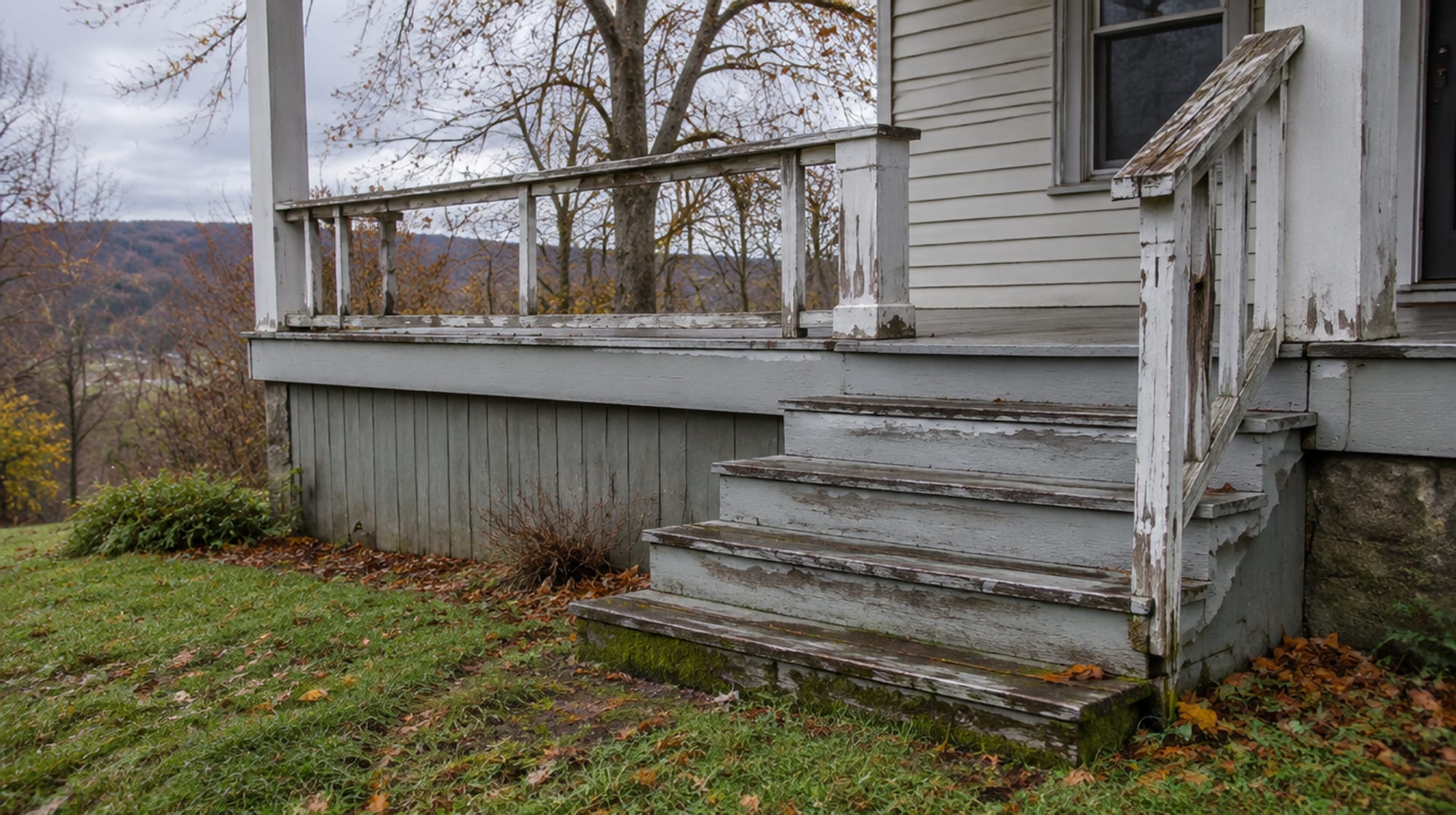
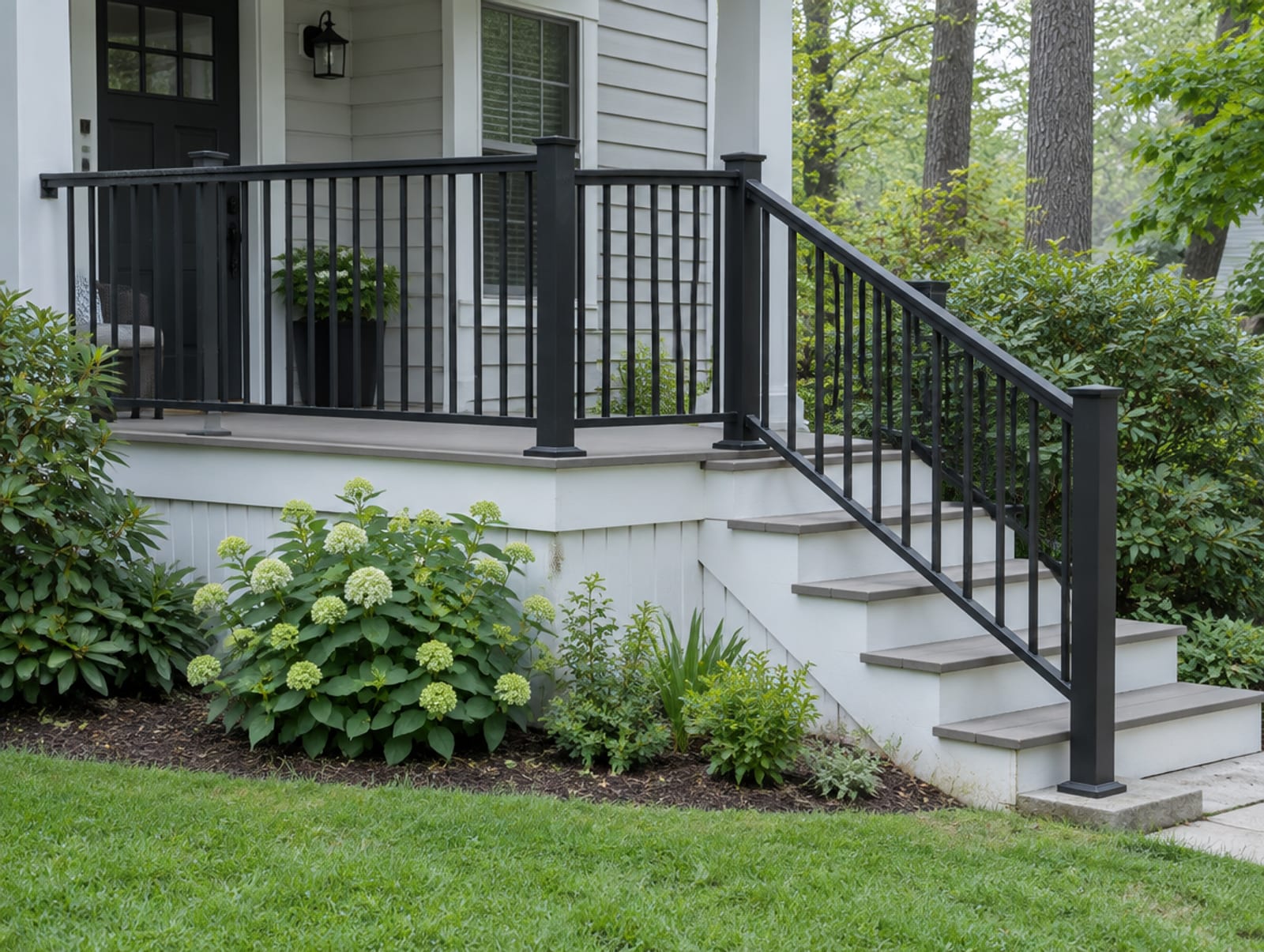
A porch railing in New York has to be at least 36 inches high, and no opening in it can pass a 4-inch sphere. The code requires one wherever the porch floor is more than 30 inches above the ground. Those numbers are the same whether the railing is vinyl, aluminum or steel, so the material choice comes down to price, finish, and how the railing handles freeze-thaw cycles and road salt.
Key Takeaways
Height and openings
36 inches minimum guard height and a 4-inch sphere limit under the 2025 Residential Code of New York State, Sections R321.1.2 and R321.1.3
When a guard is required
any open-sided walking surface more than 30 inches above the floor or grade below, measured within 36 inches of the edge
Strength
a guard must resist a 200-pound concentrated load, and the infill must resist a 50-pound horizontal load over 1 square foot
Installed price, national, per Cost Home Book
vinyl $40 to $80 per linear foot, aluminum $60 to $120, steel or wrought iron $70 to $150
Proof depends on the material
vinyl systems carry ICC-ES reports you can look up, aluminum is judged by its warranty exclusions, steel by its coating specification
What the state code requires on a porch
The edition in force as of October 2, 2026 is the 2025 Residential Code of New York State, effective December 31, 2025. These are the numbers that decide whether a railing passes.
- Section R321.1.1: a guard is required where an open-sided walking surface is more than 30 inches above the floor or grade below, measured at any point within 36 inches horizontally of the open edge
- Section R321.1.2: guards at porches, balconies and landings must be at least 36 inches high. Stair guards may be 34 inches, and a guard that doubles as a stair handrail must sit 34 to 38 inches above the stair nosings
- Section R321.1.3: openings may not pass a 4-inch sphere. On stairs, the limit is 4⅜ inches for openings generally and 6 inches for triangular openings
- Section R320.2 and R320.6: a stair handrail runs 34 to 38 inches above the nosings. A round handrail measures 1¼ to 2 inches across, and a non-round one has a 4 to 6¼ inch perimeter with a cross-section no larger than 2¼ inches
- Table R301.5: guards resist a 200-pound concentrated load applied in any direction at any point along the top, and infill and balusters resist a 50-pound load applied horizontally over 1 square foot
Towns enforce the state code and ask you to show it. The Town of Cortlandt's residential deck permit sheet, for example, asks for handrail details, guardrail details and the deck height on the plans. Before you settle on a height in Brewster, Carmel, Mahopac, Southeast, Peekskill, Yorktown, Middletown, Kingston, New City or White Plains, call that building department and ask whether the town adds a local rule to the state numbers.
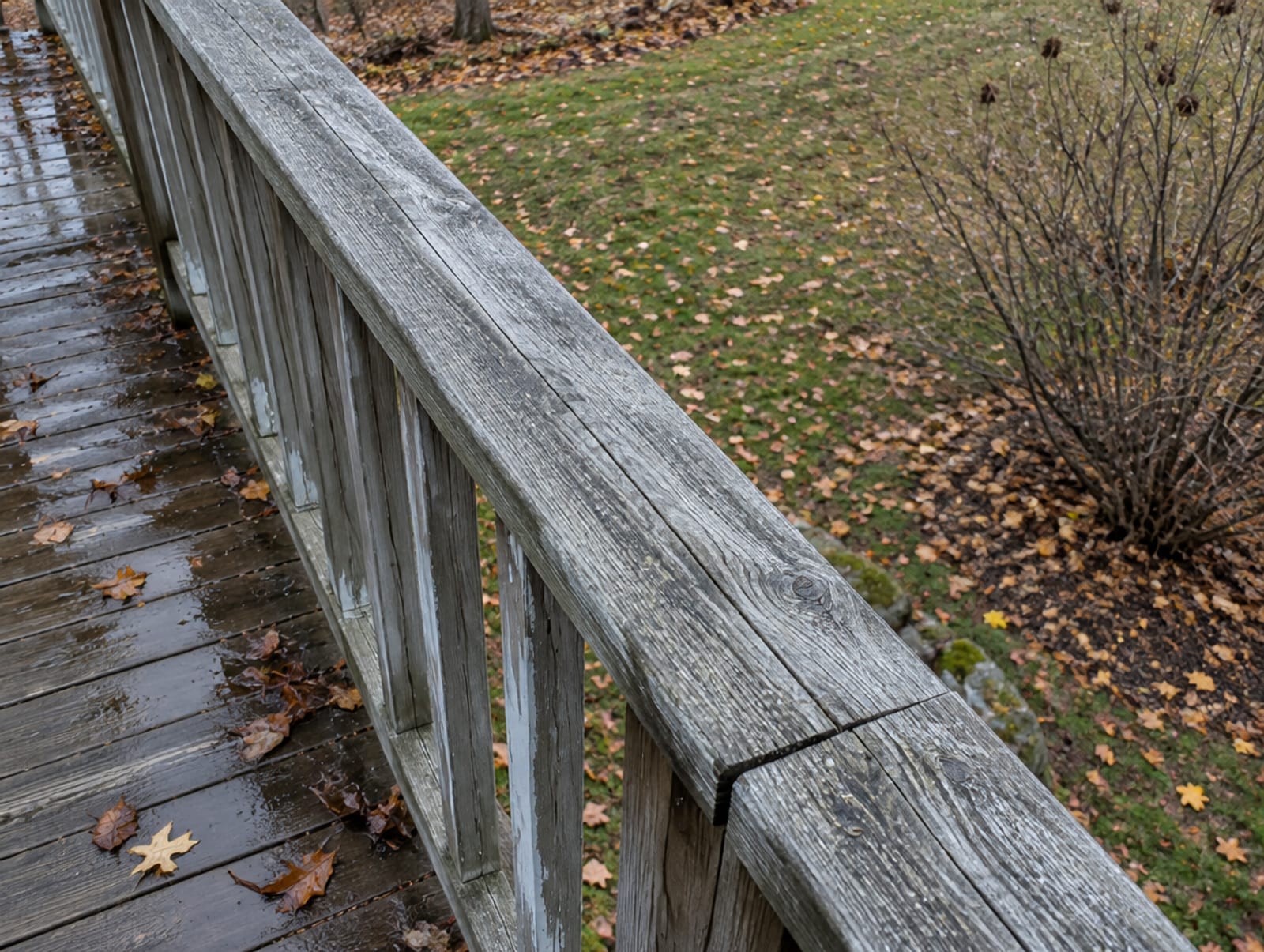
Vinyl: ask for the report number
Three vinyl railing systems carry published evaluation reports from ICC-ES, an independent code-evaluation service:
- ESR-4954: USA Vinyl and Weatherables Berkshire and related WXR and CXR systems, co-extruded PVC with aluminum rail reinforcement
- ESR-5070: Carolina Vinyl Products POLAR, KODIAK and KOALA guardrail systems, evaluated for structural strength against IBC and IRC design loads
- ESR-5570: Gallagher Vinyl Longevity Railing 1000, 2000, 3000 and 4000 Series, co-extruded rigid PVC with aluminum inserts
The test method behind them, ASTM D7032, includes temperature-effect testing at +125°F and -20°F, ultraviolet-resistance testing, freeze-thaw testing, infill-load testing and top-rail and post loading. That covers the temperature swing a New York porch sees between July and January.
A "code compliant" label on a box is a manufacturer's claim until the named system is covered by an evaluation report and installed within that report's conditions. So, ask the installer which product is going on your porch, then ask for its report number and the installation conditions it lists.
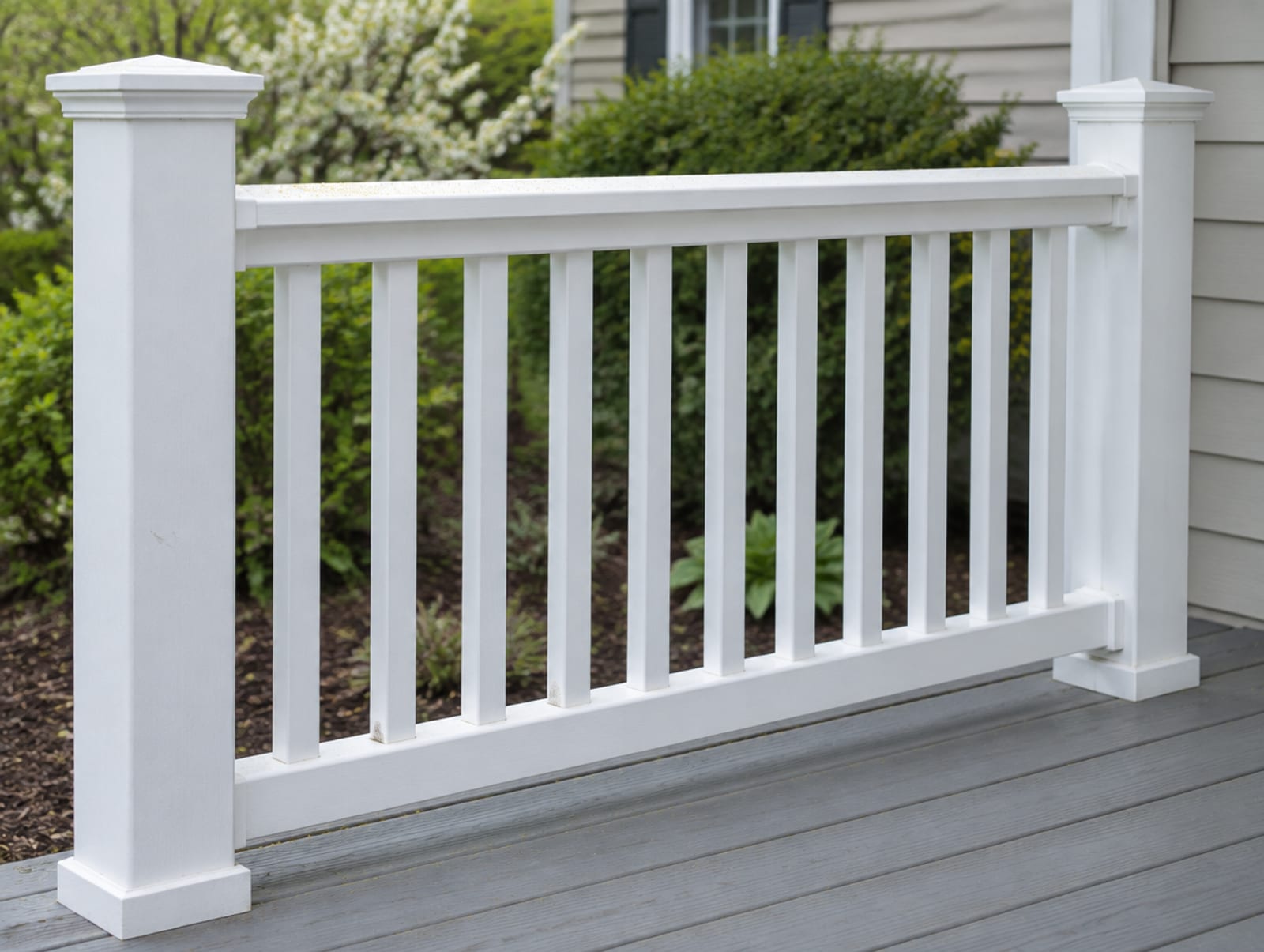
Aluminum: read the warranty exclusions
Two published aluminum railing warranties show how different the paper can be.
Fortress Al13 PLUS has a FortressLock powder-coat finish and a limited lifetime warranty. The exclusions are the part to read. They include abrasion, harsh chemicals, pool chemicals and ice-removal chemicals, and surface corrosion that starts from scratches, nicks and dents. Quarterly maintenance is a condition of coverage. The product sheet names an "Alloy Tube" without giving the alloy grade, so ask for the alloy designation and the coating system in writing before you order.
Regal ideas Aluminum Railing System carries a 20-year prorated structural warranty and a 10-year prorated finish warranty against blistering, cracking, peeling or flaking. Its exclusions include labor, normal weathering, fading, chalking, scratching caused by corrosive atmospheric contaminants, and failure to follow maintenance instructions.
Put those next to your own porch. Fortress names ice-removal chemicals in its exclusions, and Regal excludes normal weathering and corrosive atmospheric contaminants, so a set of steps that gets ice melt every winter is worth raising with the dealer before you buy.
Steel: the coating does the work
Steel railings live or die by what is on the surface. Two ASTM standards govern hot-dip galvanizing. ASTM A123/A123M covers fabricated steel products, including welded tube and assembled railings. ASTM A153/A153M covers hardware such as bolts and threaded fasteners. Under A123, coating thickness is graded by material category and steel thickness, with grades from 35 to 100, which the American Galvanizers Association equates to about 1.4 to 3.9 mils.
Powder coating goes on top for color and a second barrier. Hoosier Coatings, a coating supplier, says exterior powder coating that is properly specified can often last 10 to 20 years or longer in moderate inland conditions. It lists UV exposure, temperature swings, standing moisture, road salt, chemicals, impact and abrasion as the factors that shorten that range, and it notes that damaged areas, edges, seams, cut ends and fastener points are where corrosion starts.
So, the questions for a steel railing are specific. What zinc coating grade does the fabricator use? What pretreatment goes under the powder? How are weld seams and cut ends finished? Are the fasteners galvanized to A153? A fabricator who answers those has a railing that can be compared with another quote.
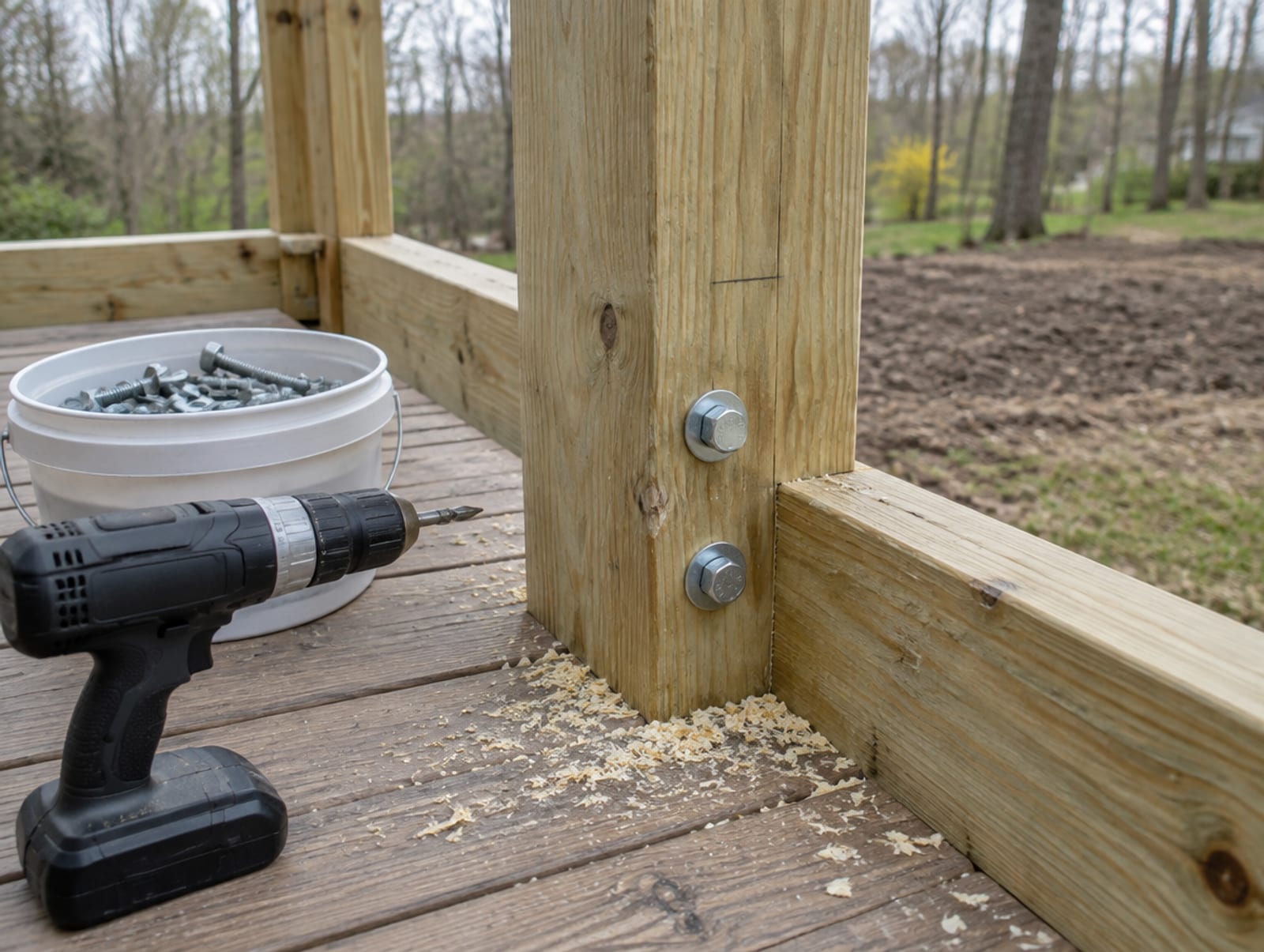
What the installed price covers
Published figures are national and should not be averaged. Each is shown as its source states it.
Vinyl: $40 to $80
Aluminum: $60 to $120
Steel or wrought iron: $70 to $150
Tap a row to open it.
All are dollars per linear foot installed. None of them is a Hudson Valley bid, and the Current Cost figures assume Midwest labor rates and standard access and railing heights.
Several things push a porch outside any of those ranges: stairs, demolition of an old railing, post reinforcement, difficult anchoring, corners, landings, custom fabrication, permits, freight, and repairs to the porch or deck framing underneath. Ask each of them to be listed as a separate line.
Check yourself
1. How high must a porch guard be under the 2025 Residential Code of New York State?
2. What size sphere must an opening in a porch guard not pass?
3. A guard is required once the walking surface is more than how far above the floor or grade below?
4. What should you ask for to back up a vinyl railing's "code compliant" label?
Frequently Asked Questions
Q: How high does a porch railing need to be in New York? A: At least 36 inches for porch, balcony and landing guards under the 2025 Residential Code. Stair guards may be 34 inches, and a stair handrail runs 34 to 38 inches above the nosings.
Q: Does a porch 24 inches off the ground need a railing? A: The state code's trigger is a walking surface more than 30 inches above the floor or grade below, measured within 36 inches of the open edge. Below that height the state code does not call for a guard, and your building department can tell you whether the town adds anything.
Q: What would 20 feet of railing cost? A: At Cost Home Book's national ranges, 20 feet comes to roughly $800 to $1,600 in vinyl, $1,200 to $2,400 in aluminum and $1,400 to $3,000 in steel or wrought iron. Stairs, corners and post work are extra.
Q: Which material lasts longest on a Hudson Valley porch? A: Compare the specific product's documents against your exposure. For vinyl, that is the ICC-ES report and the ASTM D7032 testing. For aluminum, the warranty exclusions and maintenance conditions. For steel, the zinc grade, pretreatment, powder system and edge treatment.
Q: Does a railing replacement need a permit? A: It depends on the town, and the permit sheet usually asks for the railing details and the porch height. Call the building department with your address before the work is scheduled.
The code numbers are fixed, and the material choice is where the money and the maintenance differ. A quote that names the railing system, the finish and the fasteners lets you compare one bid against another on the same terms.
At Portillo Fences and Gates, we install railings in vinyl, aluminum and steel, fabricate steel railings, and build custom fencing across Putnam, Westchester, Dutchess, Orange, Ulster and Rockland Counties. We measure the porch, confirm what your town requires, and list the system and finish on the quote. Contact us for a free estimate, or call (845) 282-3336.