

November 28, 2026
- railings
- steel railings
- maintenance
- wrought iron
A railing with surface rust and flaking paint can usually be repainted if the posts, welds and anchors underneath are still solid. Published guides put the work at roughly $2 to $12 per linear foot. The steps are: test for lead if the house is old, remove loose rust and paint, prime, then topcoat in the right weather.
Lead comes first on any house built before 1978. Old railings can carry several layers of lead paint, and sanding or burning it off sends dust into the yard. Federal rules treat a contractor doing paid work differently from you doing the work on your own home, and the next section lays out the difference.
If the metal is pitted, hollowed out or cracked at a weld, or a post has come loose from its step or porch, paint will not fix it. Those railings need repair or replacement, and the section on structural damage tells you how to spot them before you buy a gallon of anything.
Key Takeaways
Lead first
On a house built before 1978, find out whether the paint contains lead before you scrape, sand or burn anything.
Prep decides the result
Remove loose rust and flaking paint, degrease the metal, and dull any glossy surface before the primer goes on.
Follow the can
Primer and topcoat makers publish their own temperature, humidity and recoat limits, and they differ from one product to the next.
Paint cannot fix structure
Pitted metal, cracked welds and loose posts call for repair or replacement, not another coat.
Price by scope
Published repainting figures run from about $2 to $12 per linear foot, and powder coating a removed railing runs higher.
Lead Paint on a Pre-1978 Railing
The EPA's Renovation, Repair and Painting rule, 40 CFR Part 745, Subpart E, covers paid work in homes built before 1978. Under 40 CFR 745.82, it applies to renovations done for compensation unless the painted parts have been shown to be free of regulated lead paint. That threshold is 1.0 milligram per square centimeter or 0.5 percent lead by weight. If you hire someone to scrape and repaint an older railing, that contractor needs EPA certification as a firm and a certified renovator on the job.
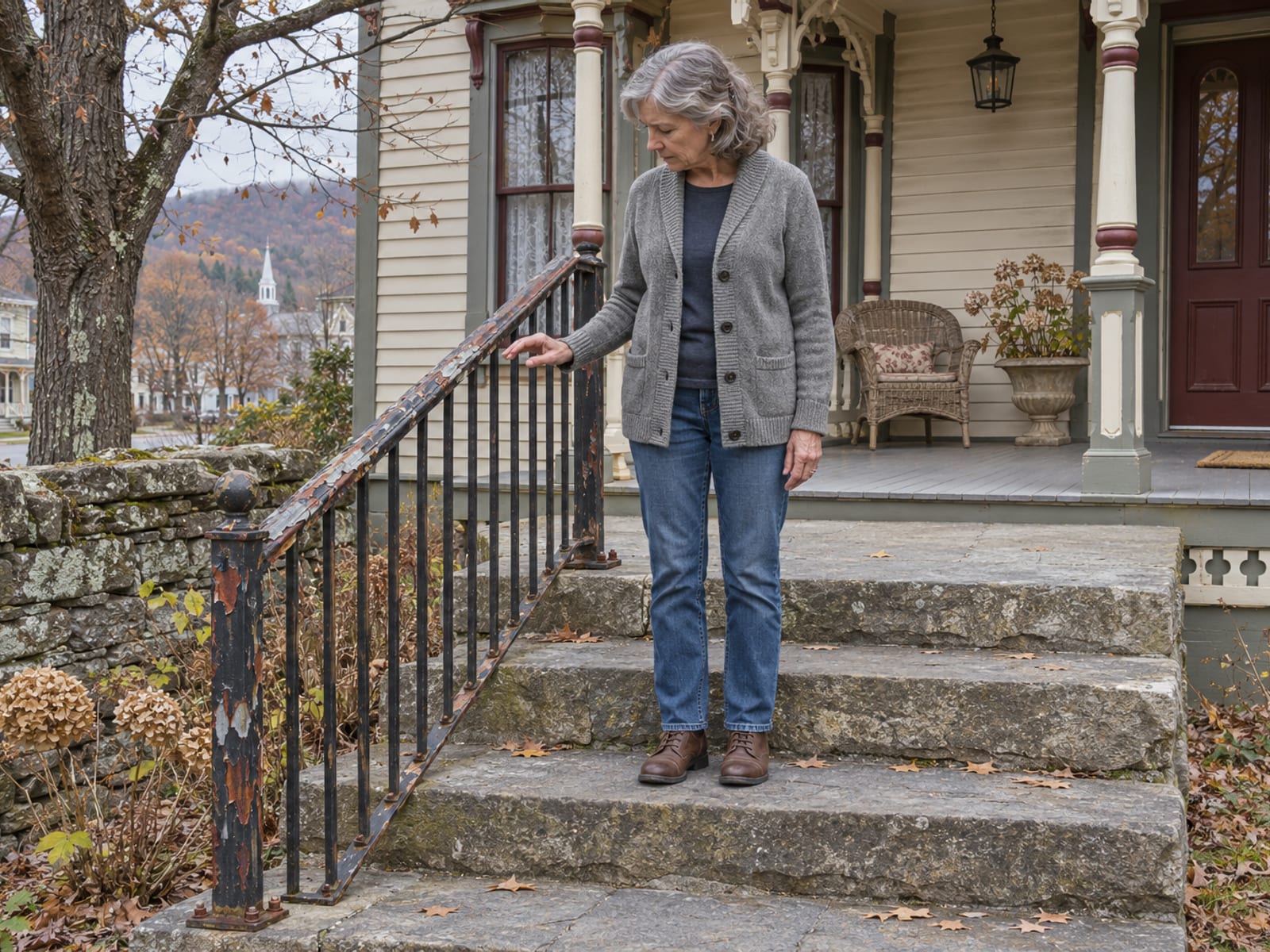
The rule for you as an owner is different. EPA states that "The RRP Rule does not impose requirements on a homeowner performing work on an owner-occupied residence." The rule can still apply if you rent out all or part of the home, run a child-care facility in it, or buy, renovate and sell homes for profit. If you do every bit of the paint-disturbing work yourself and then hire a certified firm only for work that leaves painted surfaces alone, that later work is not covered.
Doing it yourself does not make the dust harmless, so the method matters. For paid work, 40 CFR 745.85 prohibits open-flame burning or torching of painted surfaces. It bars sanding, grinding, needle guns and abrasive blasting unless the tool has a shroud or containment and a HEPA vacuum attachment. A heat gun may run only below 1,100 degrees Fahrenheit. The New York State Department of Health recommends wet scraping or wet sanding, or power sanding with a HEPA-filtered vacuum attachment. It says never to use open-flame burning, machine sanding without a HEPA attachment, abrasive sandblasting or uncontrolled power washing.
To find out what is on the metal, a certified inspector or risk assessor can test it, and paint-chip samples from the railing can be analyzed by an EPA-recognized laboratory. A written determination that the parts hold less than 1.0 milligram per square centimeter and less than 0.5 percent lead by weight takes them out of the RRP rule. Until you have that result, treat every layer as lead paint, keep children and pets away from the work area, and lay plastic under the railing to catch chips.
Preparing Rusted Steel Before Primer
Preparation is where a repaint succeeds or fails. The Society for Protective Coatings (SSPC) names the levels. SSPC-SP 1 is solvent cleaning for oil, grease and other soluble contamination. SSPC-SP 2 is hand tool cleaning, which removes loose rust, loose mill scale and loose paint with scrapers, chipping tools and wire brushes. SSPC-SP 3 is power tool cleaning with power wire brushes, grinders and needle guns, which does the same job faster.
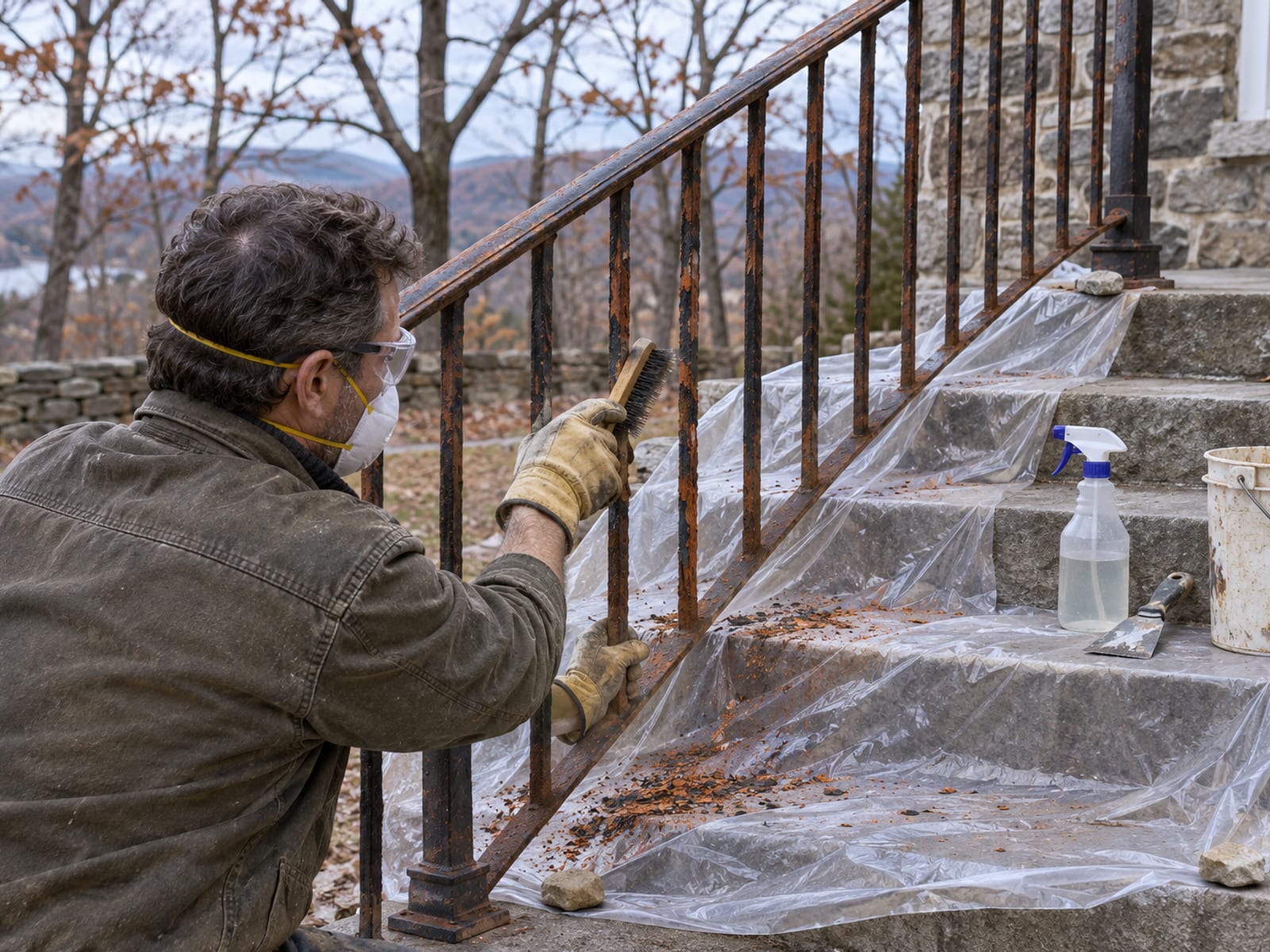
Each paint maker sets its own surface requirement for its own product, and the three big names agree on the basics. Rust-Oleum's Stops Rust Clean Metal Primer accepts bare, painted or lightly rusted metal. Its data sheet calls for removing loose paint and rust with a wire brush or sandpaper, lightly sanding glossy surfaces, then washing with soap and water, rinsing and drying. The Rusty Metal Primer sheet is for heavily rusted metal and adds dirt, oil, grease and wax to the removal list.
Sherwin-Williams' Pro Industrial DTM Acrylic Primer-Finish data sheet states that iron and steel need, at minimum, hand-tool cleaning to SSPC-SP 2 and oil and grease removal to SSPC-SP 1. It lists commercial blast cleaning to SSPC-SP 6 for better performance. Benjamin Moore's P04 Acrylic Metal Primer sheet asks for a surface free of oil, grease, dust, flaky rust, mill scale, loose paint, chalk and mildew, with glossy areas dulled by abrasion. Bare metal is cleaned with an oil and grease emulsifier or mineral spirits.
So, a workable home routine is this: degrease, scrape and wire-brush until nothing flakes off under your thumbnail, sand any shiny old paint dull, rinse, and let the railing dry completely. A higher grade such as blast cleaning needs equipment and containment, so that is a job for a coatings professional.
Primer, Paint and the Weather Window
The three makers list different systems, and the numbers below come from each maker's own data sheet, so use the sheet for the exact product on your shelf. Rust-Oleum's two primers share a recommended dry film thickness of 1.5 to 2.5 mils per coat and a topcoat window of within 1 hour or after 48 hours. Sherwin-Williams' DTM is a primer and finish in one: its sheet lists 1.9 to 3.9 dry mils per coat and two coats on steel, or one coat followed by one or two coats of an acceptable topcoat. Benjamin Moore's P04 primer lists 1.7 to 2.3 dry mils and a 2-hour recoat, followed by an appropriate Benjamin Moore alkyd or latex finish.
What three paint makers state on their data sheets for metal primers and enamels
Dry film per coat: ---
Recoat time: ---
Application limits: ---
Tap a row to open it.
Timing is where weather comes in. Sherwin-Williams says no painting should be done immediately after rain or during foggy weather, and its exterior guidance adds not to paint when rain is predicted or below 50°F unless the coating is rated for 35°F use. Benjamin Moore's WP28 data sheet says high humidity and cool temperatures lengthen dry, recoat and service times. Those sheets list touch, recoat and handling times, not a single full-cure time for a railing left outdoors, so keep hands, pets and patio furniture off the rail until the finish has hardened.
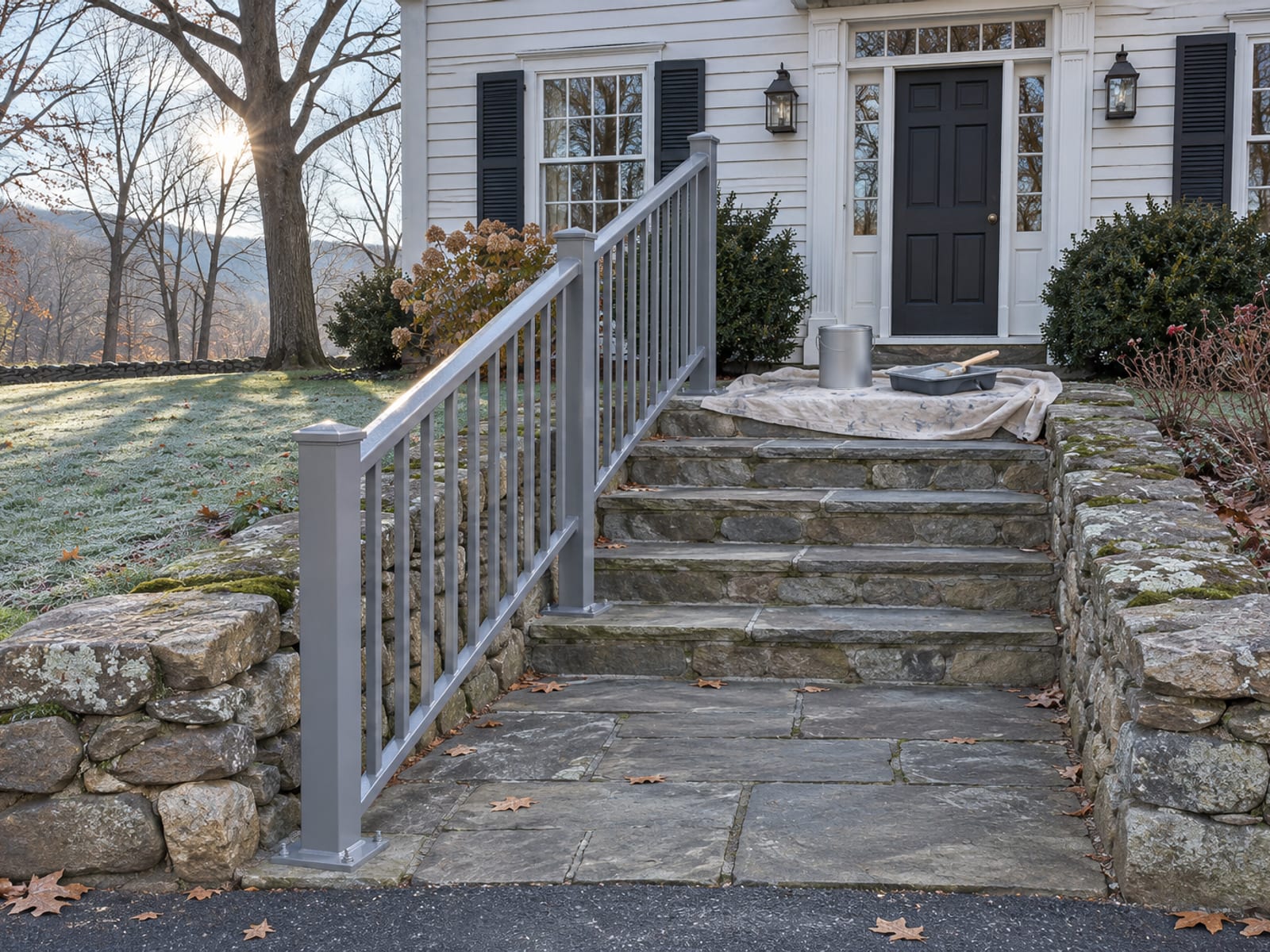
Taken together, the sheets leave a window of roughly 50°F up to 90 or 95°F on the surface, with a dry railing and no rain or fog. Only the Sherwin-Williams sheet states a dew-point gap, so read the sheet for your own product before you open the can.
Touch Up a Spot or Strip the Whole Railing
If the coating is mostly sound and the damage is in patches, spot repair is reasonable. Benjamin Moore's P04 sheet says previously painted surfaces may be primed or spot-primed as necessary, though the spot still needs loose rust, scale and paint removed first. Sherwin-Williams lists SSPC-SP 2 as the minimum spot-repair preparation on iron and steel and recommends better preparation for better performance.
There is a catch with patching. The same Sherwin-Williams sheet says preparation short of total removal of the old coating may compromise the length of service of the system. A railing with widespread peeling, rust bleeding through the finish in many places, or old coats that lift in sheets does better when you take it back to a sound surface all around, not just where you can see trouble.
Rust converters are a separate product. Rust-Oleum's Rust Reformer turns rust into a paintable black surface without sanding to bare metal, and the maker recommends its ROCPrime water-based epoxy primer before ROCAlkyd topcoats for best performance. That is a system built for that product line. It does not excuse leaving loose rust, loose scale or failed paint on the metal.
Whichever way you go, work from the top of the railing down, brush into corners and the undersides of the rails, and coat the bottoms of the posts where water sits. Those low spots rust first.
When Paint Cannot Save the Railing
Surface rust and a railing that has lost its strength look alike from the yard, and the difference matters because a porch or stair guard holds weight. Bridge inspection manuals give a useful picture of where "paint it" ends. The Minnesota Department of Transportation's Bridge Inspection Field Manual, Element 330, treats surface corrosion as compatible with continued service when strength is not affected. It escalates when there is flaking rust with section loss, a post or rail rusted through, a post or anchorage cracked through, missing fasteners, broken welds or a failed connection.
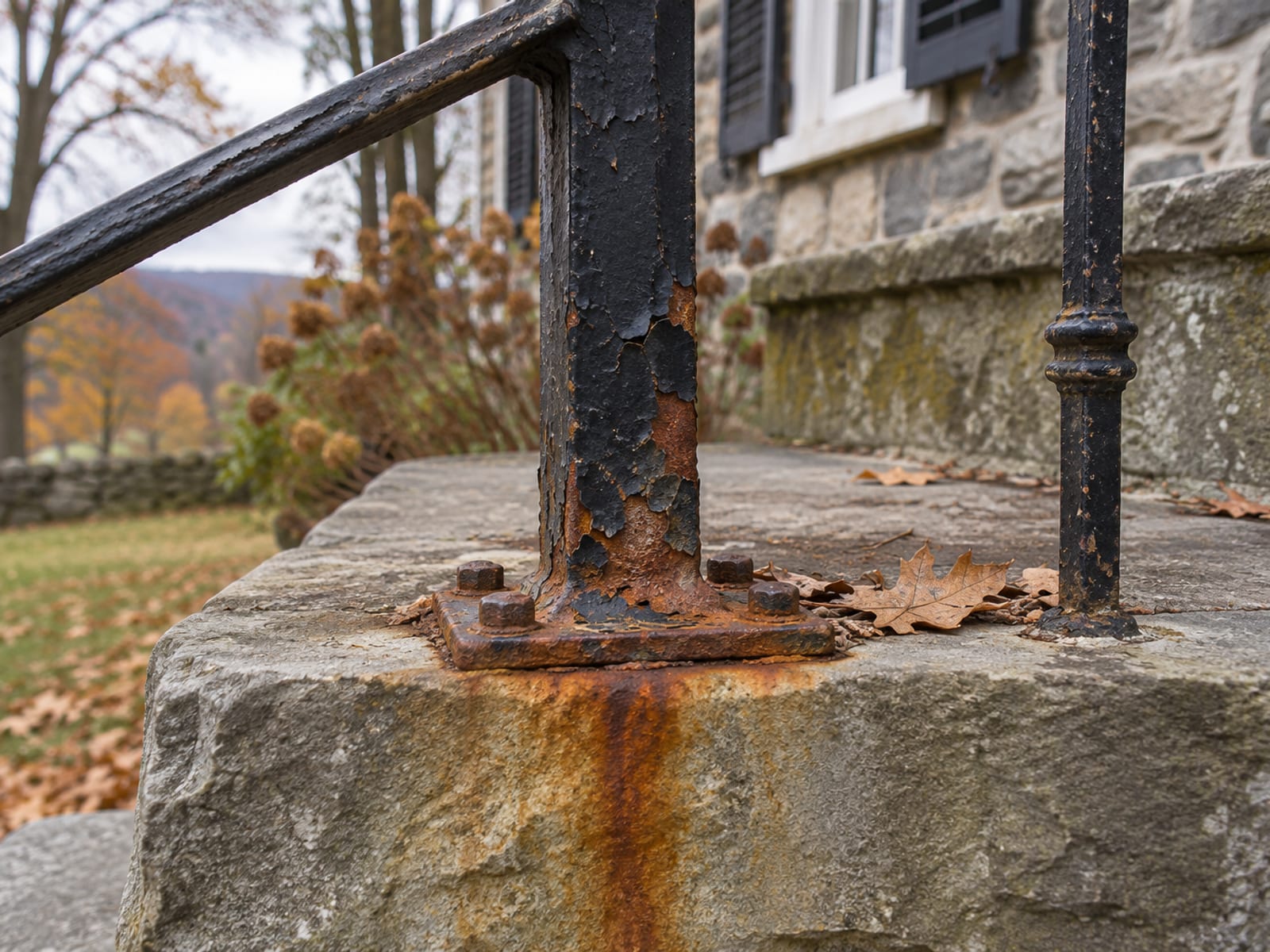
The Florida DOT bridge-maintenance manual says corroded areas should be cleaned and painted, components with section loss repaired or replaced, and damaged anchor bolts repaired or replaced. Where the anchors or the concrete holding them are damaged, it directs the user to call an engineer. These are bridge documents, not residential rules. The Minnesota manual's figure of more than 10 percent section loss as a severe condition for steel members is a bridge-inspection classification, not a residential replacement threshold.
For a home, the code that counts is the Residential Code of New York State. Section R301.5, Table R301.5 of the 2025 code lists a 200-pound concentrated load for guards and a 200-pound-per-square-foot uniform load for handrails. Those loads apply to the whole system, including posts, connections and anchorage. The code gives no percentage of rust or pit depth that decides repainting, so the practical test is physical. Push on the rail and the posts. Look at every weld. Poke any pitted or flaking spot with a screwdriver tip.
A contractor's view matches this. Signature Metal Works describes pitted, flaking or hollowed metal as a structural problem that paint cannot fix, and cracked or rusted-through welds as a failure that needs repair or replacement. If you see any of that, or a post that moves, have a qualified railing contractor or engineer look at it before you paint. A repaired or new guard also has to meet height rules; the guard height guide covers the 36-inch figure.
What Repainting Costs
Published prices for repainting differ by region and by what they include, so here is each one separately, as the publisher states it. Contractor+ gives a New York, NY estimate, updated October 3, 2026, of $2.42 per linear foot for painting metal railing, using a 100-foot minimum and a 30-percent contractor markup, with a typical total of $169.71 to $339.43.
Angi's national guide says $4 to $8 per linear foot, or $160 to $480 for 40 feet of deck railing. One and Done Prep puts it at $6 to $12 per linear foot, or $150 to $450 per railing up to 6 feet tall, and gives $200 to $275 for 25 feet of exterior stair railing with moderate rust and two coats.
Published prices for repainting, blasting and powder coating metal railing
Price as published: ---
Publisher and region: ---
Tap a row to open it.
Powder coating and sandblasting mean the railing comes off the house. Angi's powder-coating guide does not say whether its figures include removal, repairs, transport or reinstallation, so ask for a written quote that lists removal, blasting, repairs, coating, transport and reinstallation as separate lines. Those lines are where two quotes for the "same job" drift apart. The Massachusetts figures from Mass Ironworks show what a new railing costs at the other end, which is the number to hold against a big repair estimate.
Read the repainting figures as ranges for a straightforward railing. Heavy rust, lead testing, rock or steps that make staging awkward, and a long run all add time. If a railing is close to the replace line, the porch railing material comparison shows how vinyl, aluminum and steel hold up outdoors, and our guide to wrought iron railing cost and upkeep covers what keeping iron going costs over time.
Frequently Asked Questions
Do I need to test for lead if I am painting my own railing?
On a home built before 1978, yes, it is the safe move. EPA says the RRP rule does not impose requirements on a homeowner doing work on an owner-occupied residence, but dust from old paint is still a hazard to you and your family. Test first, then use wet scraping or HEPA-vacuum sanding as the New York State Department of Health recommends.
Can I paint over rust without removing it?
Only loose rust has to come off for most products. Rust-Oleum's Clean Metal Primer accepts lightly rusted metal and its Rusty Metal Primer is made for heavy rust, but both sheets still require removing loose paint and loose rust first. Rust Reformer is a separate system that converts rust to a paintable surface.
What temperature is too cold or too hot to paint a railing?
It depends on the product. Rust-Oleum's primers list 50 to 90°F, Benjamin Moore's P04 and WP28 list a surface temperature of 50 to 95°F, and Sherwin-Williams' DTM lists 50 to 120°F. Read the sheet for your can, and do not paint after rain, in fog, or on a surface that has not dried.
How do I know if the railing is past saving?
Look for pitting, flaking that exposes thinned metal, cracked or rusted-through welds, and posts that move or rust at the base. A rail that flexes when you lean on it is a structural problem. Have a railing contractor or engineer look at it before you paint.
Is powder coating better than paint?
It is a different job. Powder coating means removing the railing and having it blasted and coated, and Angi's national range is $8 to $12 per linear foot for the coating alone. Brush-on paint is done in place. Ask any quote for powder coating to spell out removal, repairs and reinstallation.
Check yourself
1. Under EPA's RRP rule, which house year range triggers the lead rules for paid work?
2. What does SSPC-SP 2 describe?
3. Which method does 40 CFR 745.85 prohibit outright on lead-painted surfaces?
4. Sherwin-Williams' DTM data sheet requires the surface to be how far above the dew point?
5. What does the code give for railing strength on a New York home?
A rusting railing is a good candidate for repainting when the metal is solid, the posts are tight and the paint is the only thing failing. Test for lead on an older house, prep to a sound surface, pick one maker's system and follow its sheet, and paint in dry weather above 50°F. If the posts, welds or anchors are doubtful, get them looked at first, before any paint goes on.
Portillo Fences and Gates builds steel railings and offers galvanizing for steel across Putnam, Westchester, Dutchess, Orange, Ulster and Rockland counties. If your railing is flaking, loose or hard to judge, contact us or call (845) 282-3336.