

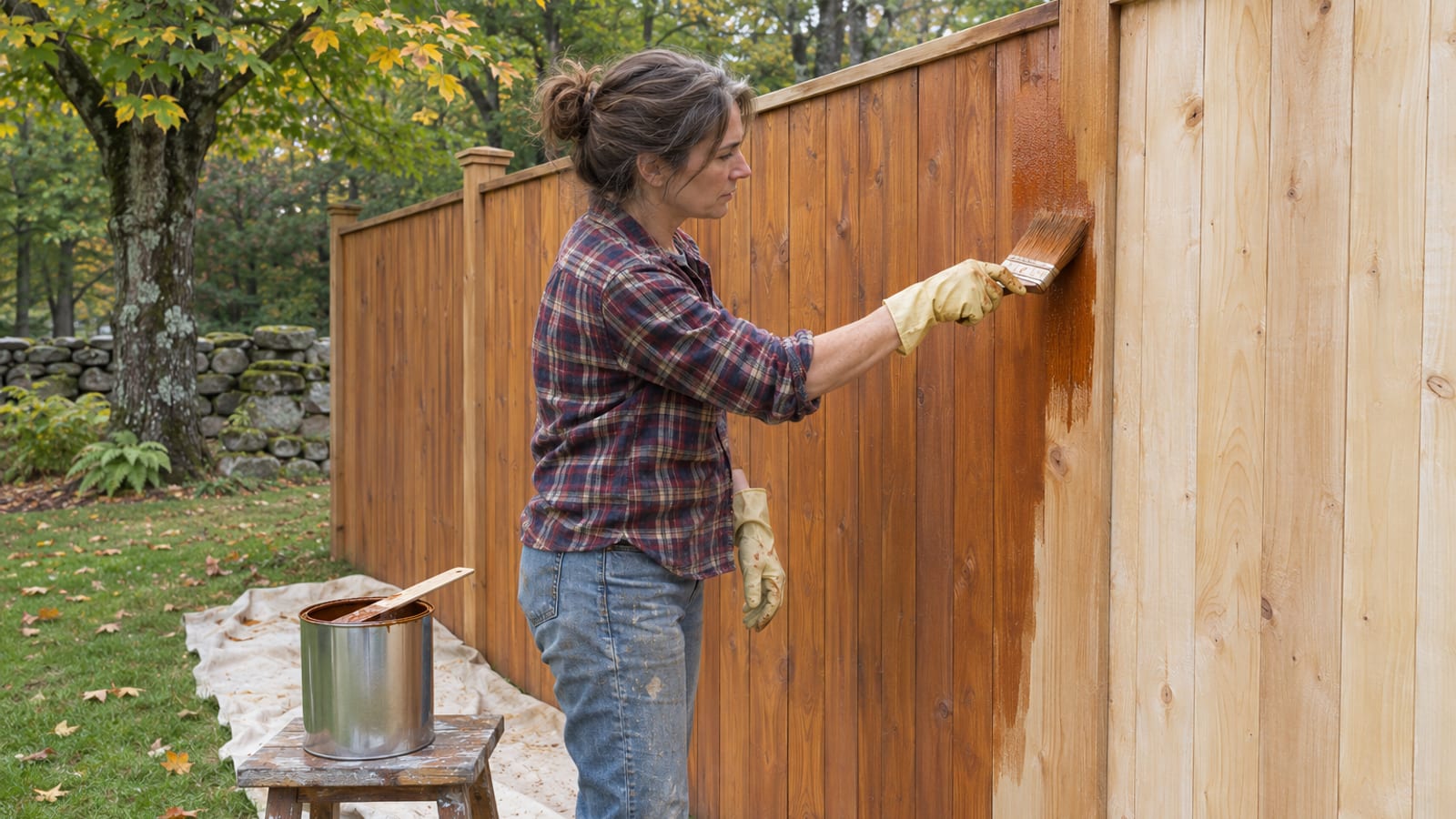
October 7, 2026
- wood fence
- fence maintenance
- staining
New pressure-treated pine can take 30 days to six months before it is ready for a finish, and new cedar is ready when its moisture content settles near 12%. Which end of that range you land on depends on the product you plan to use. A few drops of water on a board will tell you whether your fence is ready today.
Once the wood is ready, the choice is between a clear sealer, a semi-transparent stain and a solid stain. Clear sealers show the most wood and need renewing soonest. Solid stains hide the most grain and last longest. Oil-based and water-based versions of each behave differently when it is time to recoat.
Hiring it out is priced per linear foot, and published figures run from about $2 to $14 depending on fence type, prep and how many sides get coated. The sections below give the wait times, product life spans, prep steps and price ranges, each with its source.
Key Takeaways
Cedar timing
New cedar is ready to finish when its moisture content is near 12%, and the Western Red Cedar Lumber Association says to finish within two weeks if you want to keep the new look.
Treated pine timing
The Southern Forest Products Association says 30 days for an oil-based semi-transparent stain and at least six months for solid stain, paint or water-based stain on water-repellent-treated pine.
Water-drop test
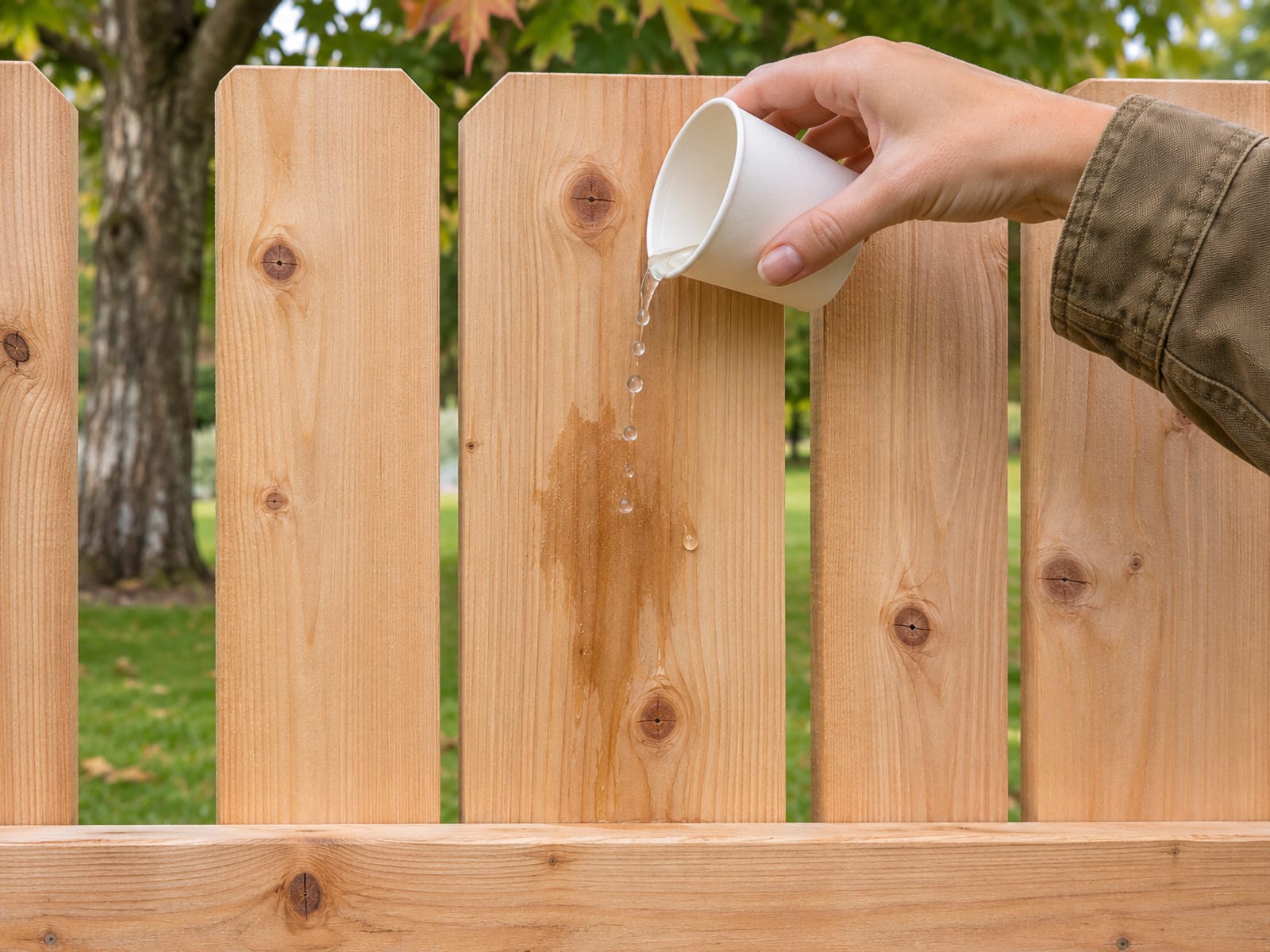
If a few drops of water soak into a board, the wood can take a finish, and if they bead up, the fence is not ready.
Product life
On cedar, clear water repellents last about one to two years, semi-transparent stains one to four, and solid stains three to six.
Weather window
Most exterior stains work between 50°F and 90°F, with 70°F to 75°F ideal and no rain for 24 to 48 hours afterward.
Price range
Published national figures run $2 to $14 per linear foot, and staining both sides can add about 80% to a one-side price.
How Long to Wait Before Staining a New Fence
Cedar and pressure-treated pine follow different clocks, so check which one you own before you pick a date. For cedar, the Western Red Cedar Lumber Association's finishing guidance says to finish when moisture content has settled near the level the wood will hold in service, about 12% in North America. It warns that wood above 20% carries a greater risk of the finish failing.
Waiting too long costs you something too. The same association says unfinished cedar left in sun and moisture for 12 weeks loses 50% of its ability to hold a film-forming finish. It recommends finishing within two weeks of installation if you want to keep the new appearance. A stain maker, Armstrong-Clark, gives a wider window: generally two to three months, or at least four to six weeks if the goal is to keep the new color.
Pressure-treated pine is slower and depends on what goes on top. The Southern Forest Products Association recommends 30 days before an oil-based semi-transparent stain on water-repellent-treated wood. For an oil-based solid stain, oil-based or latex paint, or a water-based stain, it says wait at least six months. Treated Wood says treated lumber is typically ready about 60 days after installation, but that drying depends on sun, temperature and recent weather.
So, how do you know the day has come? Use the water test. Treated Wood says to put a few drops of water on the surface. If the wood readily absorbs them, it is porous enough to accept stain, paint or sealer. If the water beads up, wait. Lumber that was kiln-dried after treatment can be ready sooner, but it should still pass the same test and meet the moisture limit on the product label. Benjamin Moore's Arborcoat technical data, for example, calls for new treated lumber to dry or reach less than 15% moisture.
If you are still choosing between the two woods, the cedar vs pressure treated pine comparison covers cost and rot resistance. Our wood fencing page shows the styles we install.
Clear Sealer, Semi-Transparent Stain or Solid Stain
The three finishes trade visible grain against how long the coating lasts. A clear sealer or water repellent keeps the natural color and grain, cuts water absorption, and can carry UV filters and mildew inhibitors. It blocks less sun than a pigmented product, so it needs renewing most often. The Western Red Cedar Lumber Association gives about one to two years on exterior cedar, while another Real Cedar page says two to four years for transparent water repellents, depending on exposure and formula.
A semi-transparent stain adds color but leaves much of the grain and texture showing. The pigment gives more UV protection than a clear product. Penetrating oil-based versions generally do not form a surface film, so they are less likely to blister or peel when moisture moves through the board.
A solid stain behaves more like thin paint. It is heavily pigmented, hides most of the original color and forms a film, which gives the strongest sun and moisture shielding of the three. It works best over primer with the number of coats the maker calls for, because one coat on new cedar is only marginally adequate. The tradeoff comes later: when a film fails, it has to be scraped and sanded before the next coat.
The Western Red Cedar Lumber Association's finish-life table puts numbers on it for cedar:
Expected finish life on exterior cedar, Western Red Cedar Lumber Association
Smooth cedar: ---
Textured cedar: ---
Tap a row to open it.
These figures were published for cedar siding, trim and decking, so treat them as starting ranges for a fence and judge the real interval by how the fence looks. The same association advises against clear film finishes such as varnish, lacquer, shellac and urethane on exterior cedar, because they turn brittle, crack and fail. For treated pine, Treated Wood says most water-repellent makers recommend yearly application and another of its FAQs says at least every two years. The label on your can controls.
Oil-Based or Water-Based
Oil-based stains soak into cedar more readily, according to Real Cedar. An oil-based semi-transparent stain goes on thin and a little messy, cleans up with mineral spirits or another solvent, dries more slowly and can smell strong. The payoff comes at recoat time. A penetrating oil-based stain usually needs only a cleaning to remove dirt, loose fibers and mildew before the next coat, not heavy scraping and sanding.
Water-based stains clean up with water, dry faster and have less odor. Real Cedar says water-based semi-transparent stains do not penetrate cedar as deeply, can form a film, and may be less durable than oil-based penetrating stains. Film buildup is the reason repeated recoats can start to peel, and semi-transparent latex stains may need scraping and sanding before you refinish. Many water-based lines still include mildew-resistant and UV-resistant versions, such as Benjamin Moore's Woodluxe water-based stain.
For a cedar fence where soaking in and easy recoating matter most, Real Cedar's refinishing guidance favors solvent-borne, oil-based semi-transparent stains. For a fence where water cleanup and low odor matter more, water-based products are practical. Read the label before switching types. A water-based stain over an old oil-based finish, or the reverse, needs the maker's prep and compatibility steps first. Where mildew is a concern, choose a product with a mildewcide or fungicide in it.
Prep for a Weathered Fence
A gray, dirty or mildewed fence needs cleaning before any coating goes on, and the order matters. Real Cedar's outdoor finishing tips call for a mild non-phosphate detergent for ordinary dirt and an oxygen-bleach solution or commercial mildew remover for mildew, followed by a thorough rinse and full drying. If cedar has grayed, a wood brightener or restorer brings back the original color before you coat it.
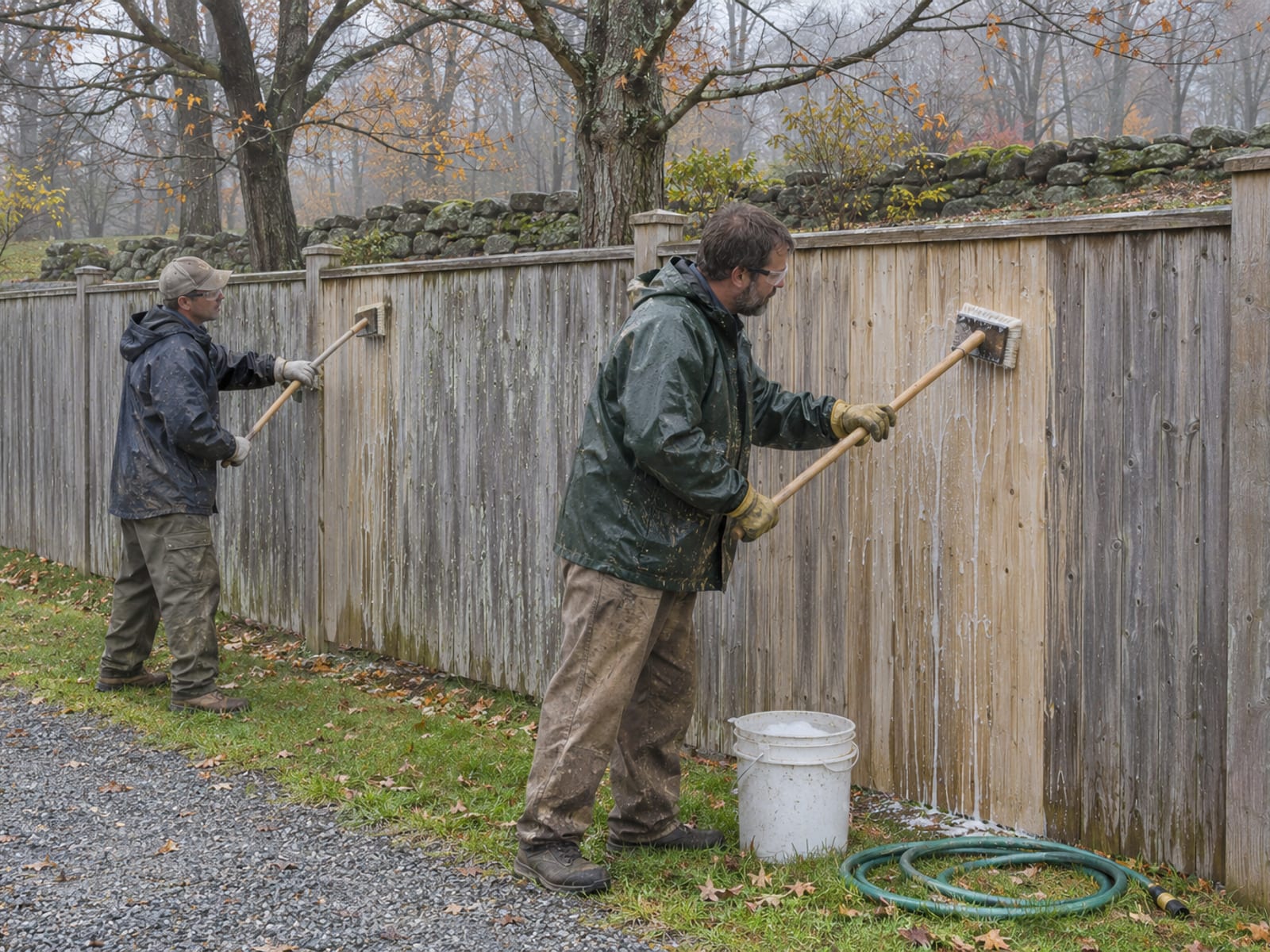
Go easy on the pressure washer. The Western Red Cedar Lumber Association warns that power washing can damage cedar surface fibers and make the next finish harder to apply. Use the least aggressive method that gets the dirt off. From there, the steps run in this order:
1. Scrape off loose, cracked or peeling film-forming finish. 2. Sand bare wood and feather the edges of any finish that stays, when you are renewing a solid stain. 3. Let the fence dry completely, then run the water-drop test again. 4. Brush a small test patch, because old coatings, new boards and repaired sections can take color differently. 5. Coat the fence, and do not stack a new layer of latex semi-transparent stain on top of one that is still sound.
Walk the fence once a year before deciding anything. Look for fading, water soaking in instead of beading, mildew, peeling, cracking and bare end grain. Recoat when the finish no longer repels water or the film is failing, rather than waiting for a calendar date. If you find soft or leaning boards, sort the repairs first, since finish does not fix rot. Our fence repair service covers that, and repair or replace explains how to decide.
The Weather Window in the Hudson Valley
Product labels set the conditions, not the calendar. Sherwin-Williams gives 70°F as the optimum for most exterior stains, with a general safe range of 50°F to 90°F. It says to avoid high humidity, hot surfaces, direct sun and staining right after rain, and to allow two to three days of drying after a rainstorm. A second Sherwin-Williams guide puts the ideal conditions at 70°F to 75°F with 40% to 70% relative humidity and no rain forecast for 24 to 48 hours.
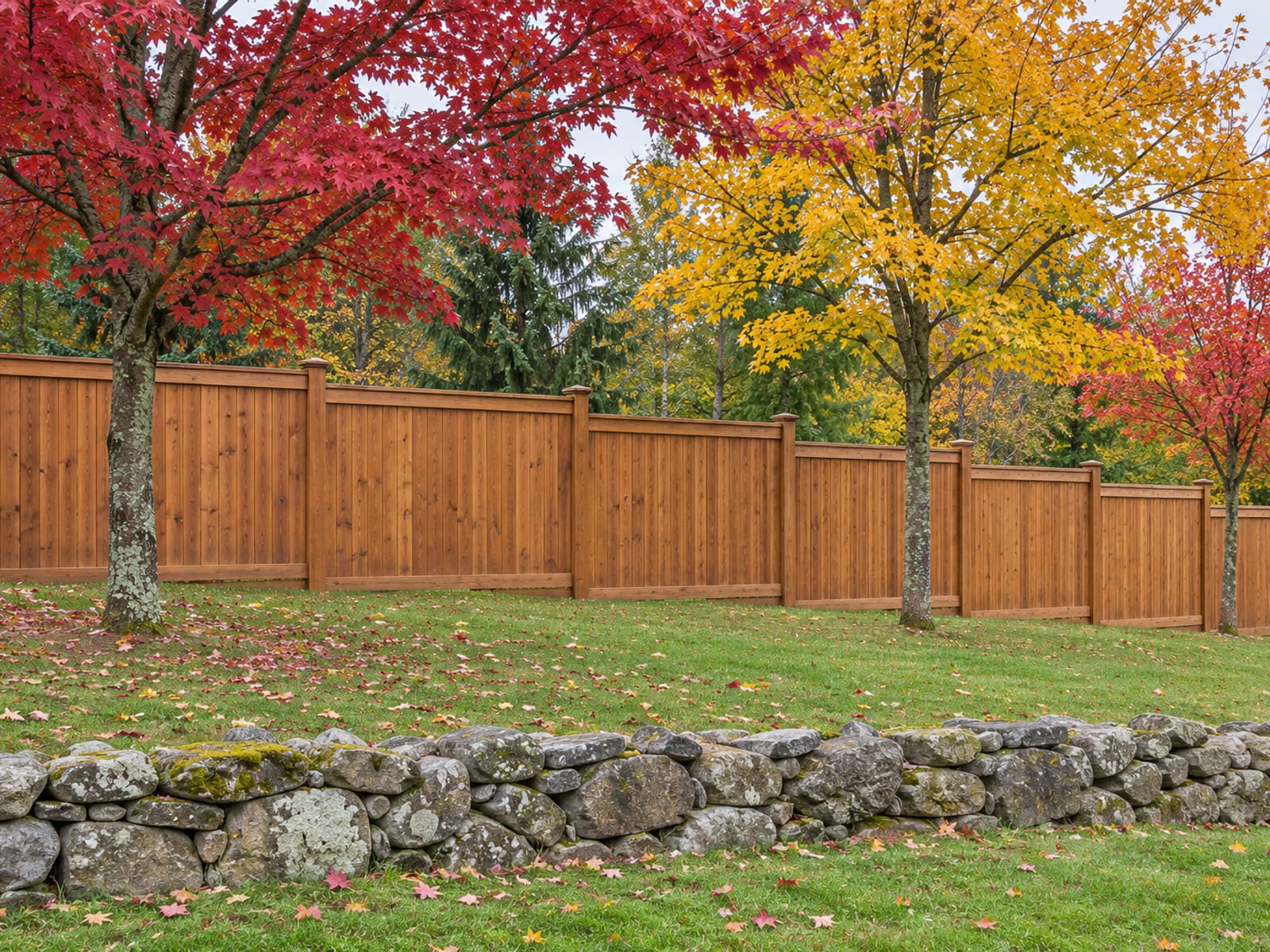
Benjamin Moore's Arborcoat waterborne semi-transparent stain lists a surface-temperature range of 40°F to 90°F. Its technical data says the drying and recoating times are measured at 77°F and 50% humidity, and that cool temperatures and high humidity stretch them. In the Hudson Valley that points to spring and fall, with a caveat. Late in the season, a cold night, dew or rain can hit a coat before it cures, and freeze-thaw swings make that risk real. Pick a stretch where the fence is dry, the surface stays inside the label's range, and the forecast gives you the rain-free days the product asks for.
If you are also planning a new install, when to install a fence in the Hudson Valley lines up the build season with the finishing window.
What Hiring It Out Costs
Published fence-staining prices are national or from other regions, and they differ on what is included. HomeGuide reports $2 to $14 per linear foot, or $0.50 to $2.50 per square foot, for fence painting or staining. It splits that into $1 to $9 for labor and $1 to $5 for stain, paint and supplies. For wood, it gives $2 to $5 per linear foot for picket fences and $3 to $10 for privacy fences.
Angi's 2026 guide reports $4 to $14 per linear foot, based on staining one side. It lists labor at $50 to $110 per hour and says staining both sides can add about 80% to the one-side cost. Pittsburgh Fence Company, a Northeast contractor, publishes $4 to $8 per linear foot for stain and sealer, priced for freeze-thaw cycles, and $6 to $10 per linear foot for pressure washing and brightening.
Published fence-staining prices by source
Price: ---
What it covers: ---
Tap a row to open it.
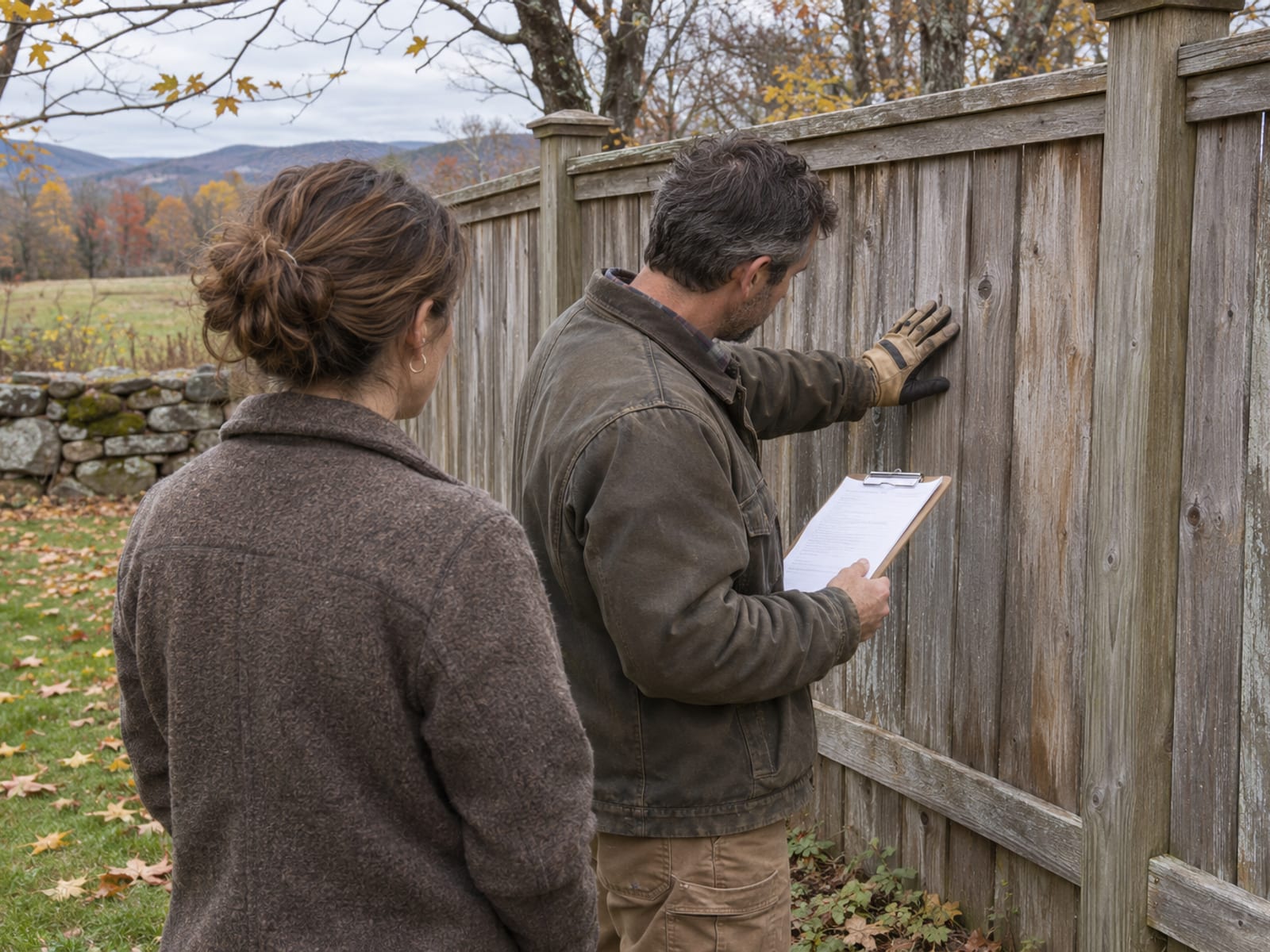
None of those figures is a Hudson Valley quote, so use them as a way to read an estimate rather than as a price. Ask for a written estimate that lists linear footage, number of sides, washing, brightening, sanding, mildew treatment, repairs, product, labor and cleanup. Height, picket spacing, shadow-box construction, gates, access and the state of the old coating all move the number. The fence estimate checklist lists what a quote should spell out.
Frequently Asked Questions
How long should I wait to stain a new cedar fence?
Finish cedar when its moisture content settles near 12%. The Western Red Cedar Lumber Association says to finish within two weeks of installation to keep the new look, and Armstrong-Clark gives two to three months as a general range. A water-drop test and a small test patch settle it for your fence.
How long should I wait to stain new pressure-treated pine?
The Southern Forest Products Association says 30 days for an oil-based semi-transparent stain and at least six months for a solid stain, paint or water-based stain on water-repellent-treated wood. Treated Wood says about 60 days is typical. If water soaks in when you drop it on the board, the wood is ready.
Is a stain or a sealer better for a fence?
It depends on what you want to see. A clear sealer shows the most wood and lasts about one to two years on cedar. A semi-transparent stain adds color and lasts one to four years, and a solid stain lasts three to six but hides the grain and forms a film.
Can I pressure wash a wood fence before staining?
You can clean it, but go gentle. The Western Red Cedar Lumber Association warns that power washing can damage cedar fibers and make the new finish harder to apply. A detergent scrub, an oxygen-bleach or mildew remover and a thorough rinse are the milder route.
What temperature is right for staining a fence?
Sherwin-Williams gives 70°F as the optimum for most exterior stains, with a safe range of 50°F to 90°F, and wants no rain for 24 to 48 hours afterward. Benjamin Moore's Arborcoat allows 40°F to 90°F on the surface. Check the label on your product.
How much does it cost to have a fence stained?
Published figures run from $2 to $14 per linear foot nationally, and Pittsburgh Fence Company publishes $4 to $8 per linear foot for stain and sealer. Staining both sides can add about 80%. Ask for a local written estimate that shows sides, prep and product.
Check yourself
1. What moisture content does the Western Red Cedar Lumber Association give as the target for finishing new cedar in North America?
2. What does a bead of water sitting on top of a pressure-treated board tell you?
3. Which finish does the Western Red Cedar Lumber Association give the longest expected life on smooth cedar, three to five years?
4. What temperature does Sherwin-Williams give as the optimum for most exterior stains?
5. How much can staining both sides add to the cost, according to Angi?
Stain a fence when the wood has dried enough to soak up water, the weather holds between 50°F and 90°F, and a rain-free stretch is ahead. Pick the finish by how much grain you want to keep and how often you want to repeat the job, then walk the fence each year and recoat when water stops beading.
If you want a hand with the wood itself, Portillo Fences and Gates builds and repairs wood fences in Putnam, Westchester, Dutchess, Orange, Ulster and Rockland counties. See our wood fencing and fence repair pages, contact us for an estimate, or call (845) 282-3336.