

November 2, 2026
- pool fencing
- above-ground pools
- New York code
An above-ground pool wall can serve as your barrier in New York, but only when it is a rigid structure at least 48 inches high and the ladder or steps are controlled. If any of that is missing, the pool needs a fence or another barrier around it.
The rule sits in the 2025 Residential Code of New York State (RCNYS), Section R328.4.2.9. It applies to any residential pool that can hold more than 24 inches of water, which covers nearly every above-ground pool sold for a backyard.
Three things decide your setup: the height and build of the wall, what happens at the ladder, and whether a deck gives anyone a way onto the water. Your town building department decides what it wants to see on the permit, so the last section covers that.
Key Takeaways
Wall as barrier
A rigid above-ground pool wall can be the barrier under 2025 RCNYS R328.4.2.9 when it meets the 48-inch height and gate rules.
Ladder and steps
The ladder or steps must lock, fold up or come off, and any opening left behind must stop a 4-inch sphere.
Soft-sided pools
A flexible or inflatable wall does not qualify just because it measures 48 inches, so plan a fence around it.
Decks
A deck that gives access to the pool needs a compliant barrier and a self-closing, outward-swinging, self-latching gate.
Alarm
A pool alarm that meets ASTM F2208 is a separate requirement, and the wall-as-barrier option does not waive it.
Fence kits
Most top-mount fence kits stand 24 or 36 inches above the pool rail, so check the total height against grade before you buy.
When the pool wall counts as the barrier
Section R328.4.2.1 asks for a permanent barrier at least 48 inches above grade, measured on the side facing away from the pool, with no more than 2 inches of clearance underneath. Section R328.4.2.9 then lets the above-ground pool structure itself serve as that barrier, or lets you mount a barrier on top of the structure. Section R328.3.2 requires above-ground pools to comply with ANSI/APSP/ICC 4.
The wall has to meet R328.4.2.1 through R328.4.2.8 as well, which includes the 48-inch height and the gate rules. So, a rigid metal or resin frame pool with a wall that stays 48 inches above the ground all the way around is the typical case that works. The State's above-ground pool guidance adds that the barrier must sufficiently obstruct access and that the manufacturer must certify the structure's design.
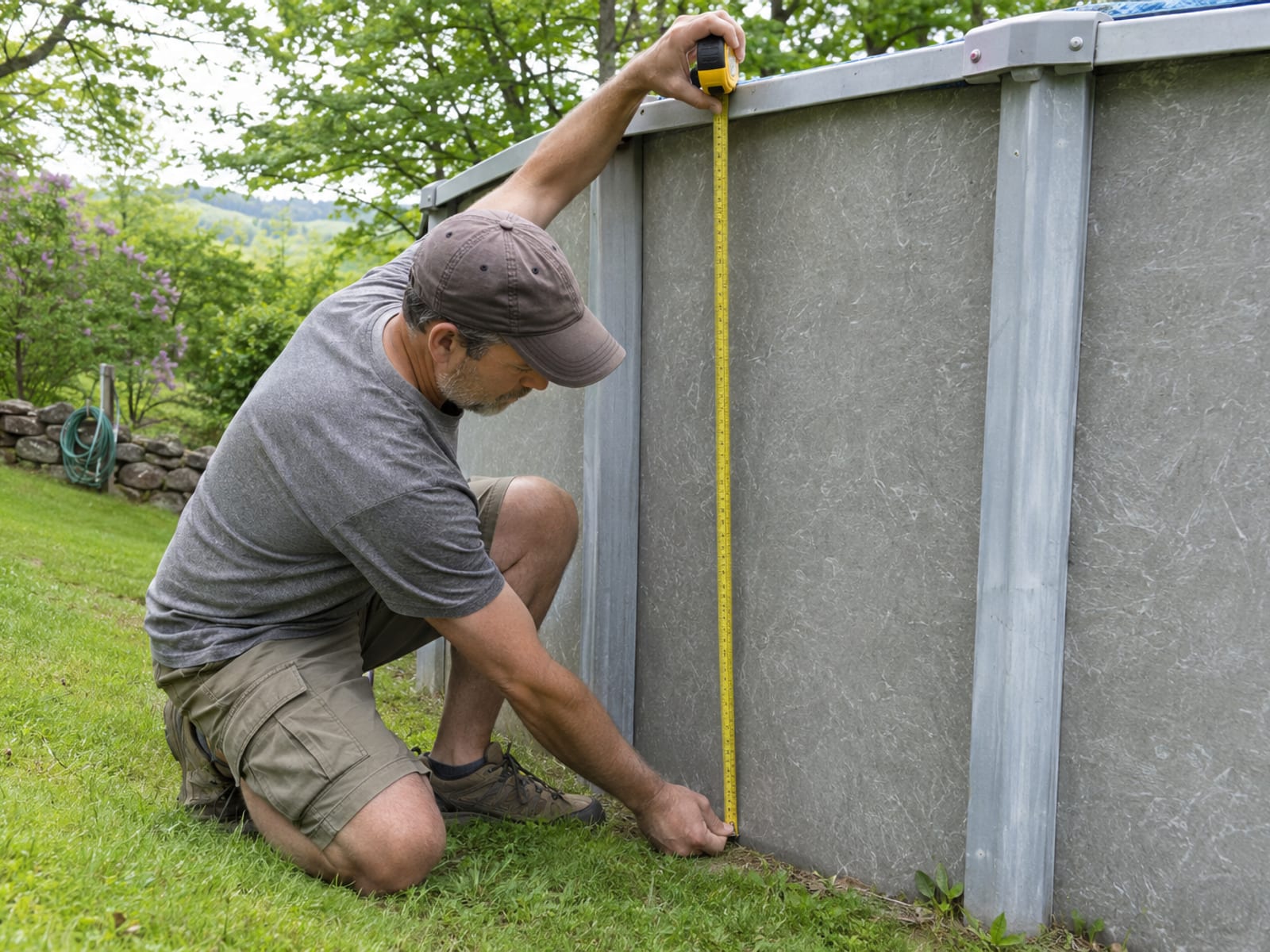
Soft-sided, self-set and inflatable pools are the common problem. They can stand 48 inches tall and still fail, because a flexible wall can be pulled or pushed and is not a rigid structure. The Town of Patterson's pool packet says plainly that temporary or inflatable pool walls cannot serve as the barrier, while rigid PVC or metal-frame pools may if they keep 48 inches around the whole perimeter.
Ground that falls away matters too. If your yard slopes, the wall measures shorter on the downhill side, and the 48 inches is measured from grade there. A pool set into a hillside or on a raised pad needs that figure checked on every side.
For the height, gap and gate rules that apply to every New York pool, the NY pool barrier rules article covers them. If your pool sits against the house, read using your house wall as a pool barrier before you count that wall.
Ladders and steps
The ladder is the access point, and it is where most above-ground pools stop qualifying. Section R328.4.2.9 gives you two ways to handle it. The ladder or steps can be secured, locked or removed so nobody can climb them, or they can be surrounded by their own barrier that meets R328.4.2.1 through R328.4.2.8.
Any opening that appears when you flip up, lock or remove the ladder cannot let a 4-inch-diameter sphere pass. That means a flip-up ladder with a gap under it may still fail, and a ladder that you lift out and store has to be put away every time the pool is not in use.
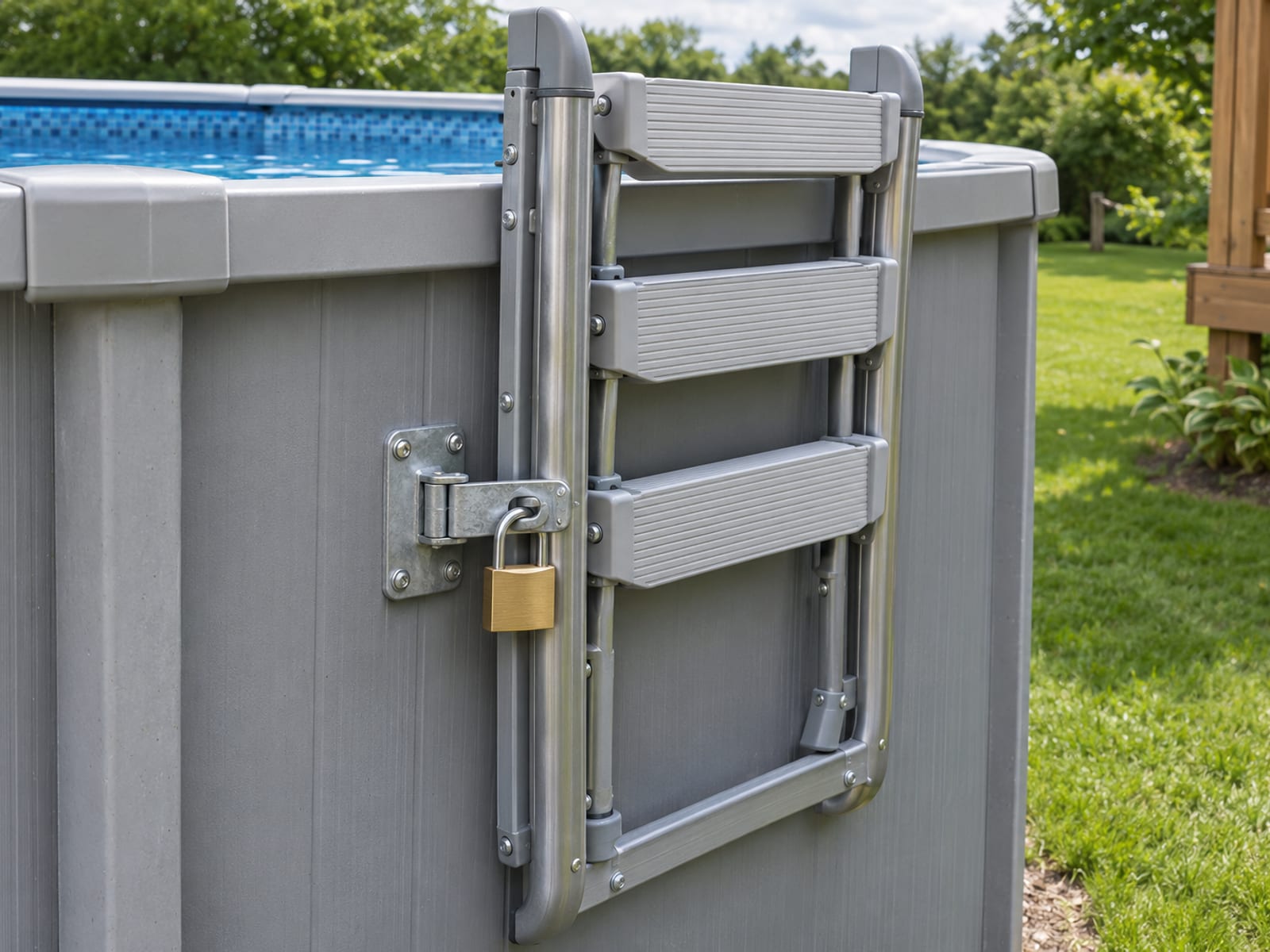
Many town packets ask for the ladder detail up front. Port Chester's above-ground permit package asks for a retractable ladder or other permanent-barrier brochure, and the Town of Newburgh's 2026 packet asks for ladder details under R328.4.2.9. Bring the product literature for your exact ladder to the permit counter.
The Town of Ulster has its own code on top of the state rule. Its Town Code Section 165-4 lets an above-ground pool at least 4 feet high use stairs that fold and lock, or are removable, instead of the fence that Section 165-3 otherwise requires. The town code states that its provisions apply notwithstanding the State Uniform Code, so a pool in Ulster follows the local text.
Decks built around an above-ground pool
A deck attached to the pool does not replace the barrier. If the deck gives anyone a path to the water, the pool must still be completely enclosed by a barrier that meets R328.4.2. The deck stairs or any other access point have to be controlled by a gate or by another barrier arrangement.
The deck also carries its own guard rule. Under 2025 RCNYS R321.1.1, guards are required on open-sided surfaces more than 30 inches above the floor or grade below, and R321.1.2 sets the guard height at 36 inches minimum, with openings that stop a 4-inch sphere. A 36-inch deck guard is not a 48-inch pool barrier, so the two rules have to be read together. Our deck and porch guard heights article covers the guard side.
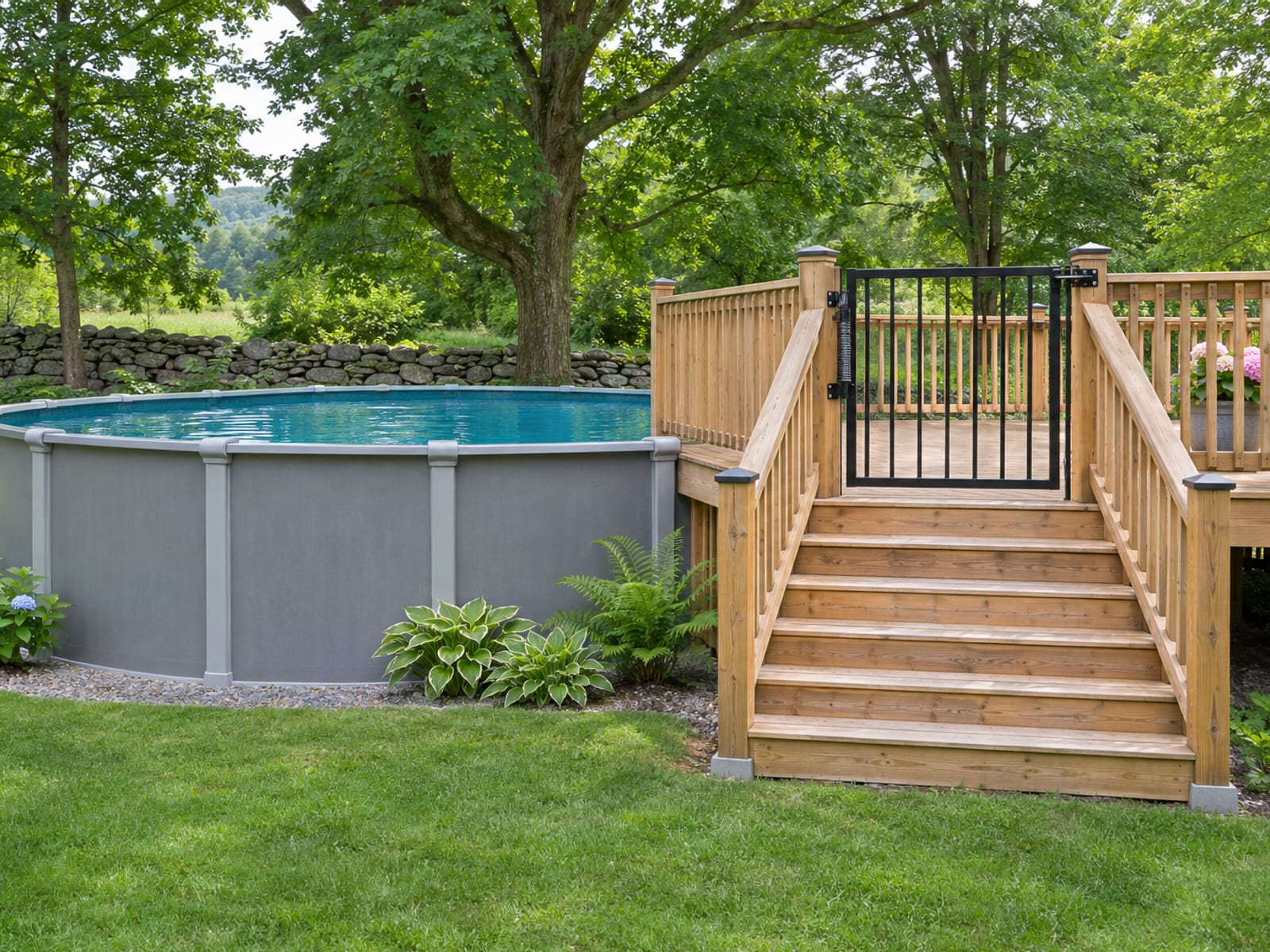
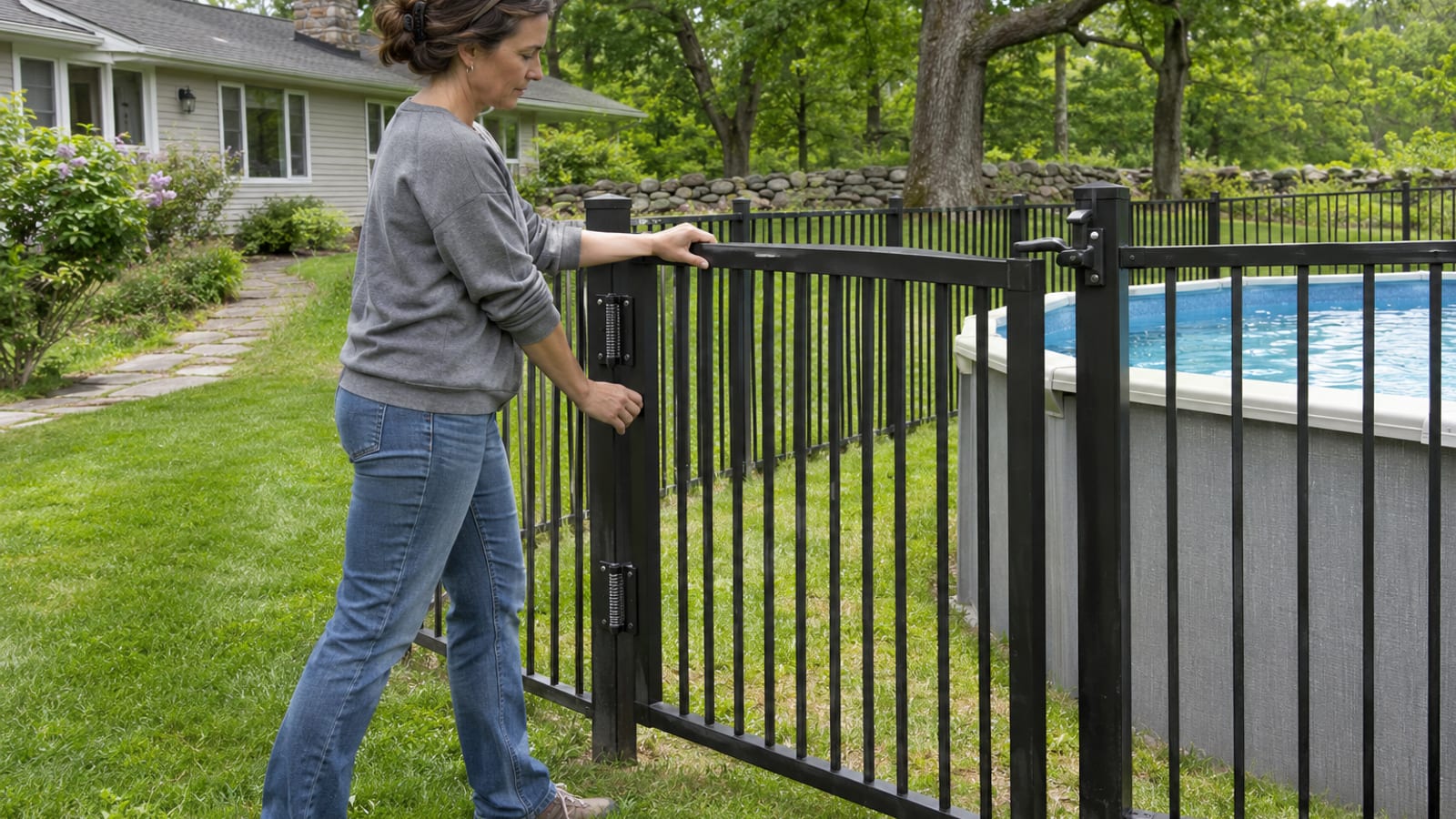
The gate is the part inspectors check closely. Under R328.4.2.7 a pool gate must be self-closing and self-latching, and a pedestrian gate must open outward, away from the pool. The latch handle goes on the enclosure side at least 40 inches above grade. If the latch sits less than 54 inches above grade, it must be at least 3 inches below the top of the gate, and openings within 18 inches of the latch cannot exceed one-half inch. The gate also has to be locked with a key, combination or child-proof lock when the pool is not in use or supervised.
Whether a given deck guard can also count as part of the pool barrier depends on its height, layout and relationship to the pool structure. Ask the building department to review the deck plan and the barrier plan together, before you build either one.
The pool alarm and what towns ask for
Section R328.6 requires an approved pool alarm on a pool installed, constructed or substantially modified after December 14, 2006. The alarm has to meet ASTM F2208, detect entry at any point on the water surface, and sound both poolside and inside the house where someone monitors it. A personal immersion alarm does not satisfy the section. The only exceptions are a spa with an ASTM F1346 safety cover and a pool with an ASTM F1346 automatic power safety cover. The pool-wall-as-barrier option does not remove the alarm requirement.
The 2025 RCNYS became fully effective on December 31, 2025, per the Department of State's notice of adoption. Older town handouts may still cite Section R326 of the 2020 code, where the same alarm rule appeared as R326.7, so read them alongside the current section numbers.
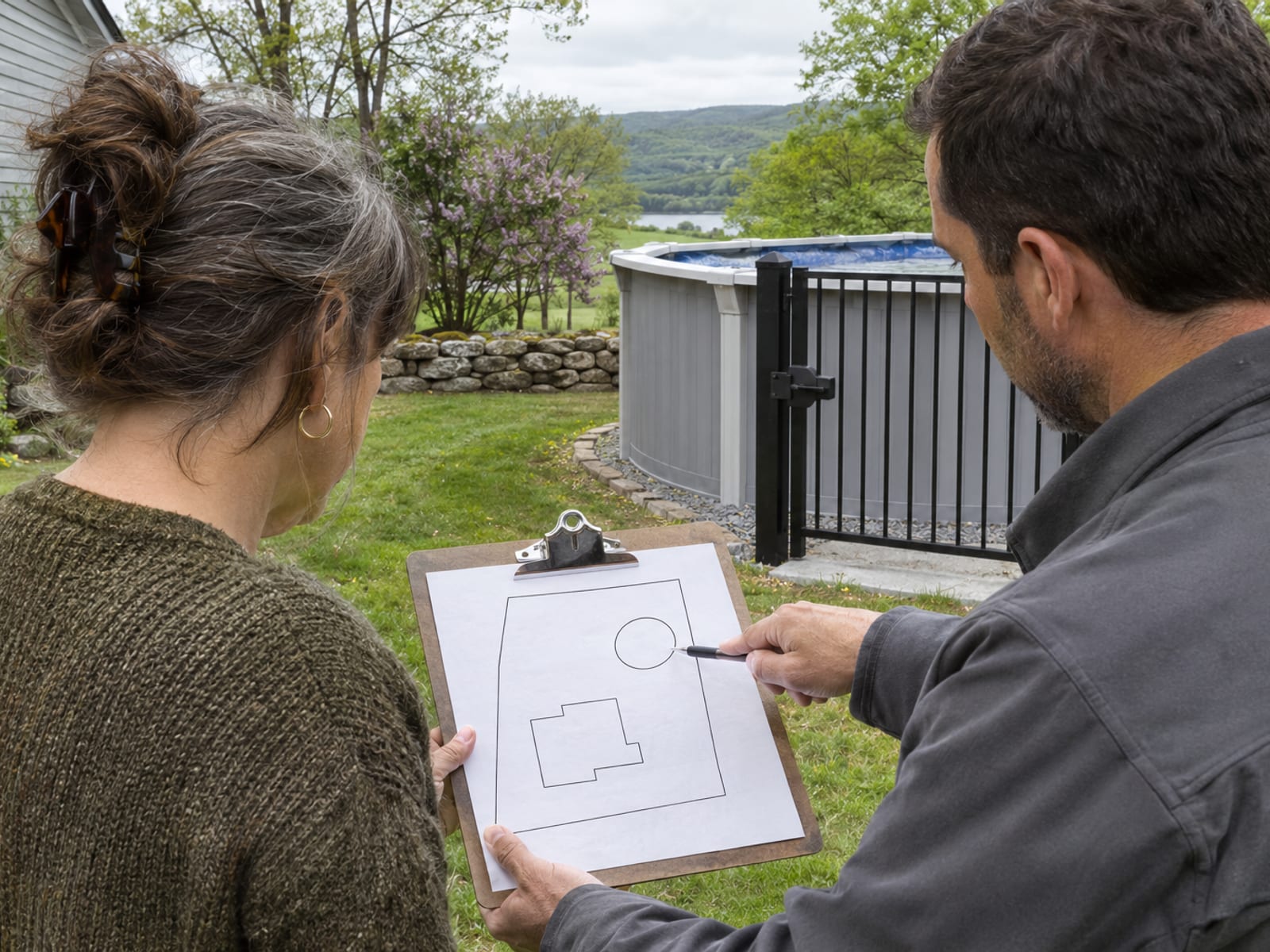
Towns in the six counties publish what they want. Patterson, in Putnam County, requires a permit for any pool that holds 24 inches or more of water, including inflatable ones, and its pool information packet asks for a survey, an ASTM F2208 alarm and a 48-inch barrier with a self-closing, self-latching gate. Wappinger, in Dutchess County, has an above-ground pool permit application and a separate alarm certification that requires the alarm to work at poolside and inside the house.
In Westchester County, Port Chester's above-ground pool permit packet wants a site plan that shows the pool, any deck and the barrier type, and the Town of Mamaroneck asks for a separate permit for the barrier or fence. Newburgh, in Orange County, asks for alarm, ladder, gate, door and window details. You can read the Town of Newburgh's 2026 pool permit packet for a full example.
For a pool in Rockland County, or in any town not named here, call the local building department before you order anything. For a homeowner's pool, the town or village building department is the office that issues the permit, not the county health department.
Fence kits that mount on the pool, and what they cost
Some pools need more than the wall, and a mount-on fence is the common answer. These kits attach to the pool's top rail or uprights and are made for rigid-wall pools. Their listed heights are usually 24 or 36 inches above the rail, so a kit by itself does not create a 48-inch barrier measured from grade. You have to add the wall height, the fence height and your ground level, and check the total at the access point.
Mount-on above-ground pool fence kits, prices as listed in November 2026
Listed height: ---
Price as listed: ---
Tap a row to open it.
Vinyl Works Canada also makes its Premium Resin system in a 36-inch height. The Sentry Safety installation guide says its fence is not a handrail for decking and does not meet handrail codes, so do not count it as a deck guard. GLI's Protect-A-Pool uses mounting brackets that connect to the pool structure; confirm its current price and height with the maker.
Prices come from different sellers and change, so treat each one as a data point, not an average. A kit is also only part of a compliant setup. The gate, latch, ladder control and alarm still have to meet the sections above, and the building department decides whether your arrangement passes.
Frequently Asked Questions
Do I need a fence if my above-ground pool wall is 48 inches tall?
Not always. A rigid pool wall that meets R328.4.2.1 through R328.4.2.8 can serve as the barrier, but the ladder or steps must be locked, secured or removed, or surrounded by their own barrier. A flexible or inflatable wall does not qualify just because of its height, so those pools need a separate barrier.
Does an above-ground pool need an alarm in New York?
Yes, under 2025 RCNYS R328.6. The alarm must meet ASTM F2208, detect entry anywhere on the water surface, and sound poolside and inside the house. A personal immersion alarm does not count, and using the pool wall as the barrier does not waive the alarm.
Can a 24-inch fence kit on top of my pool make it code compliant?
On its own, no. The code figure is 48 inches above grade at the barrier, so the pool wall height, the kit height and your ground level have to add up at every point. Ask the building department to confirm your numbers before you buy.
Does my deck count as the pool barrier?
Only if the deck's height, layout and relationship to the pool meet R328.4.2, and the deck stairs or access point are controlled by a self-closing, self-latching gate that opens outward. The deck guard rule of 36 inches under R321.1.2 is separate from the 48-inch pool barrier, so ask the building department to review both plans together.
Who do I call about a permit for an above-ground pool?
Your town or village building department. It issues the permit for a homeowner's pool, and its packet lists the barrier, ladder, gate and alarm details it wants to see. The county health department generally handles public or regulated pools, not backyard ones.
Check yourself
1. What is the minimum barrier height above grade under 2025 RCNYS R328.4.2.1?
2. Which pool wall does not qualify as a barrier just because it is 48 inches high?
3. What must the opening left by a locked or removed pool ladder not allow to pass?
4. Which way must a pedestrian pool gate swing?
5. Does the wall-as-barrier option remove the pool alarm requirement?
A rigid wall at 48 inches, a ladder that locks or comes off, a self-latching gate wherever a deck meets the pool, and an ASTM F2208 alarm are the pieces to line up before you call for a permit. If you are also weighing a removable fence, read removable mesh pool fence rules in New York.
If your pool needs a fence or a gate that meets code, Portillo Fences and Gates can look at your yard through its pool fencing and aluminum fencing work in Putnam, Westchester, Dutchess, Orange, Ulster and Rockland counties. Use our contact page or call (845) 282-3336.