

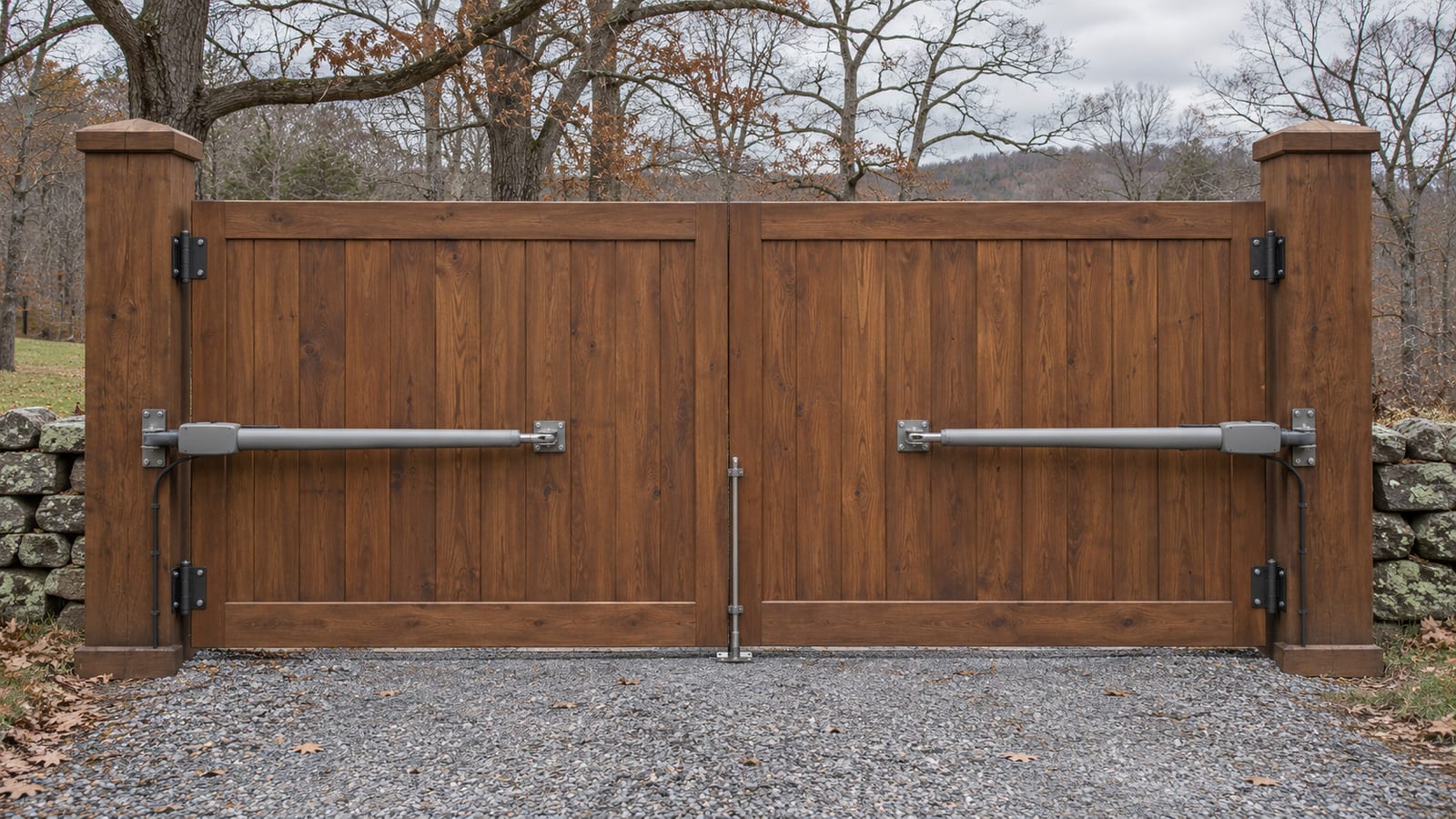
November 25, 2026
- gate operators
- automatic gates
- UL 325
A heavy driveway gate is sized by four things: its weight, its length, how much wind it catches, and how many times a day it runs. Makers publish limits for each of these, model by model, and a gate that goes past any one of them will wear out an operator early.
If your gate is long, solid, or opened dozens of times a day, read the limit for your gate's actual length, because ratings such as the LiftMaster LA500's drop as the leaf gets longer.
Below you will find the published limits for FAAC, LiftMaster and Viking Access operators, how wind changes the choice on a solid gate, what UL 325 usage classes mean, and what heavy duty operators cost.
Key Takeaways
Length changes the rating
A swing operator's weight limit shrinks as the leaf gets longer, so read the rating at your gate's length, not the headline number.
Wind is its own load
A solid gate catches more wind than a picket gate, and weight and length alone do not tell you whether an operator will cope.
Class is not capacity
UL 325 usage classes describe where an operator is used, such as a home or a store, and say nothing about how much gate it can move.
Residential means Class I
UL 325 Class I covers a home with one to four single-family dwellings, and larger multifamily sites fall into Class II.
Prices vary widely
Angi's 2026 national figures run from $1,000 to $6,000 for swing gates and $6,000 to $10,000 for cantilever gates, before heavy-duty extras.
Test it monthly
LiftMaster's CSW200UL manual calls for monthly entrapment protection tests and more frequent checks under heavy use.
What Decides the Size of a Gate Operator
Start with the gate, not the motor. Measure the length of each leaf if it swings, or the full panel if it slides, and get a real weight. Solid infill adds weight over an open picket gate of the same size, so get the real figure from the fabricator or a scale before you pick a model.
Then count the cycles. One cycle is one open and one close. A family that opens the gate a few times a day has very different needs from a property with deliveries, staff, and a gate that stays busy from morning to night. Makers publish cycle ratings for exactly this reason: FAAC lists its 400 family at 80 cycles per hour, while LiftMaster's SL585 slide operator lists 20 cycles per hour at every motor size.
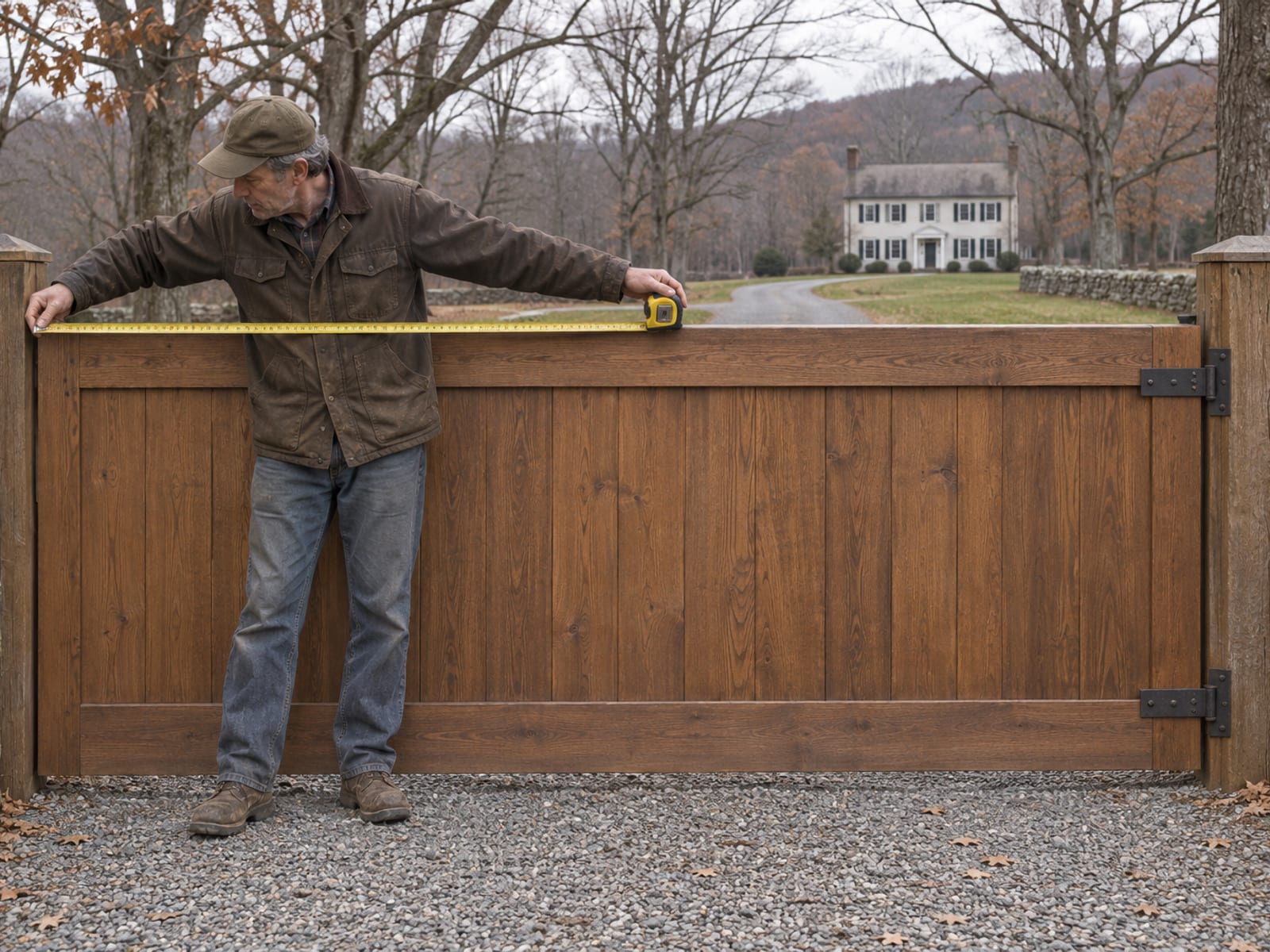
Environment and condition count too. FAAC's 400 brochure states that environmental conditions and the condition of the gate affect the duty cycle you can actually reach. A sagging leaf, dry hinges or a bent track makes the motor push harder on every pass, so the published number only holds when the gate is square and moves freely. If you are still deciding between a swinging and a sliding gate, Swing or Slide: Choosing a Driveway Gate covers that choice first.
Published Weight and Length Limits
The table lists the limits the makers publish. Read the entry for your gate's length, and keep in mind that several of these documents are old. The FAAC 415 sheet is dated 2007, the LiftMaster LA500 sheet August 2015 and the SL585 sheet January 2012, so ask the installer to confirm the current model and rating before you buy.
Published operator limits from FAAC, LiftMaster and Viking Access
Type: ---
Weight limit: ---
Length limit: ---
Duty rating: ---
Tap a row to open it.
The figures come from the FAAC 415 specification sheet, the FAAC 400 brochure, the LiftMaster LA500 product sheet, the LiftMaster CSW200UL product page, the LiftMaster SL585 specification sheet, and Viking's pages for the X-390, G-5, L-3 and Q-7.
Reading the Table Against Your Gate
The LA500 shows why the headline number misleads. LiftMaster rates it for gates up to 18 feet or 1,600 pounds, but the rating table gives 1,600 pounds only at 8 feet, 1,200 pounds at 12 feet, 800 pounds at 16 feet and 600 pounds at 18 feet. Viking's G-5 works the same way, at 2,000 pounds on a 10-foot leaf and 800 pounds on an 18-foot one. A long gate and a heavy gate are two different problems, and you have to clear both.
Duty ratings split the field too. The FAAC 415 at 115 VAC is rated for 25 cycles per hour, and the 24 VDC version is rated for a 100 percent duty cycle. LiftMaster lists the CSW200UL as a high-traffic commercial operator with continuous duty, while Viking's K-2 slide operator and R-6 swing operator are identified by Viking as residential and Class I, at 700 pounds each. Viking's K-2 page and R-6 page carry those listings.
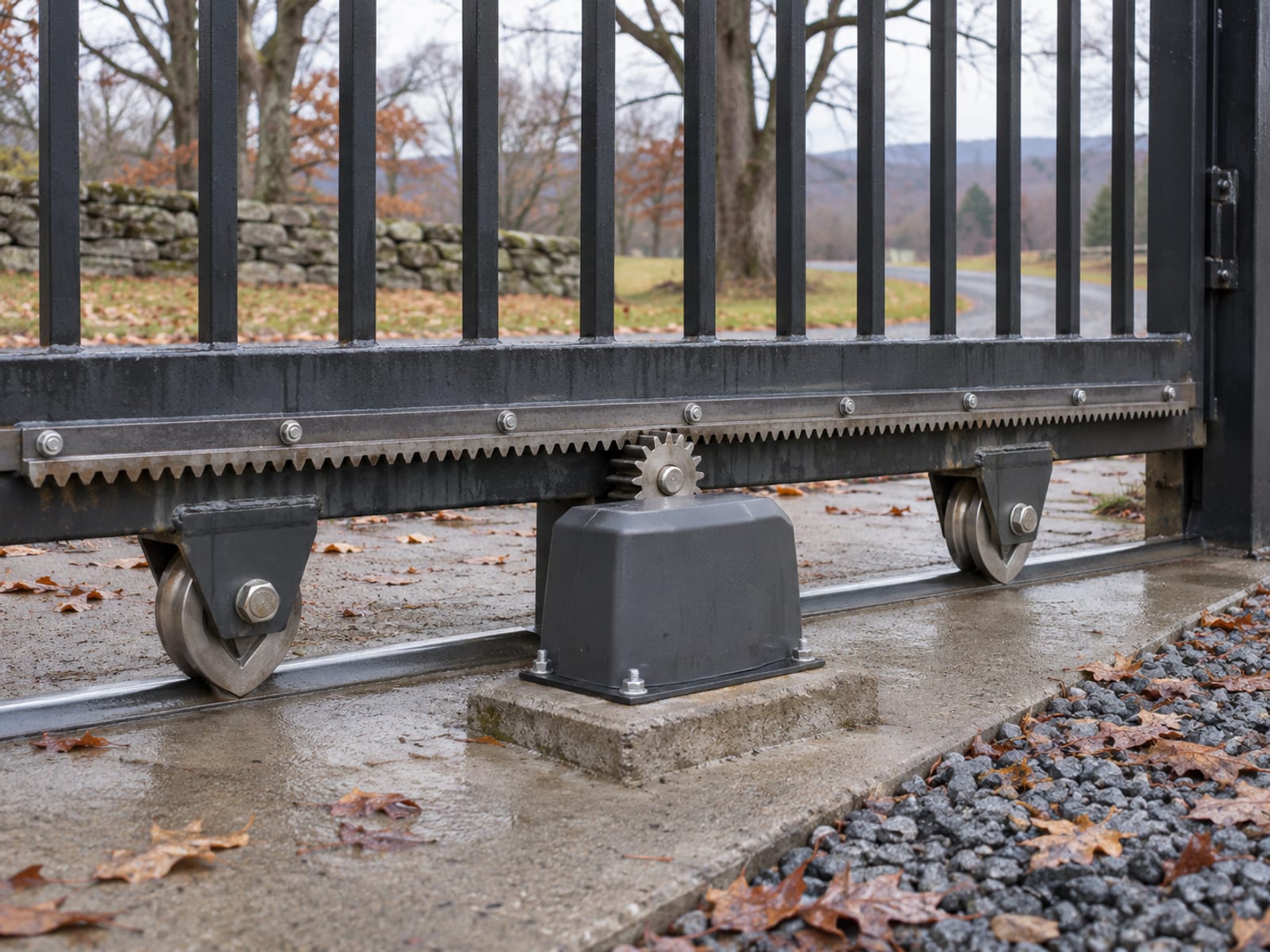
Slide operators trade a different set of limits. The SL585 handles much longer openings than any swing operator in the table, up to 75 feet on an overhead or V-groove gate, but a cantilever gate cuts that to 40 feet. If your opening is wide, slide operators are the place to start.
Wind Load on Solid and Semi-Solid Gates
A solid gate is a sail. It presents far more surface to the wind than an open picket or ornamental gate of the same size, and that load lands on the operator, the hinges, the posts, the brackets and the foundation. A gate that sits inside the published weight limit can still be a poor match if its wind area is large.
FAAC USA points buyers to its hydraulic Model 400 when a gate is very heavy or wind is a deciding factor, and lists the Large Leaf configuration at up to 23 feet and 2,000 pounds per leaf. FAAC also says the installer should select the configuration for the site's application. Both statements are on FAAC USA's swing gate page.
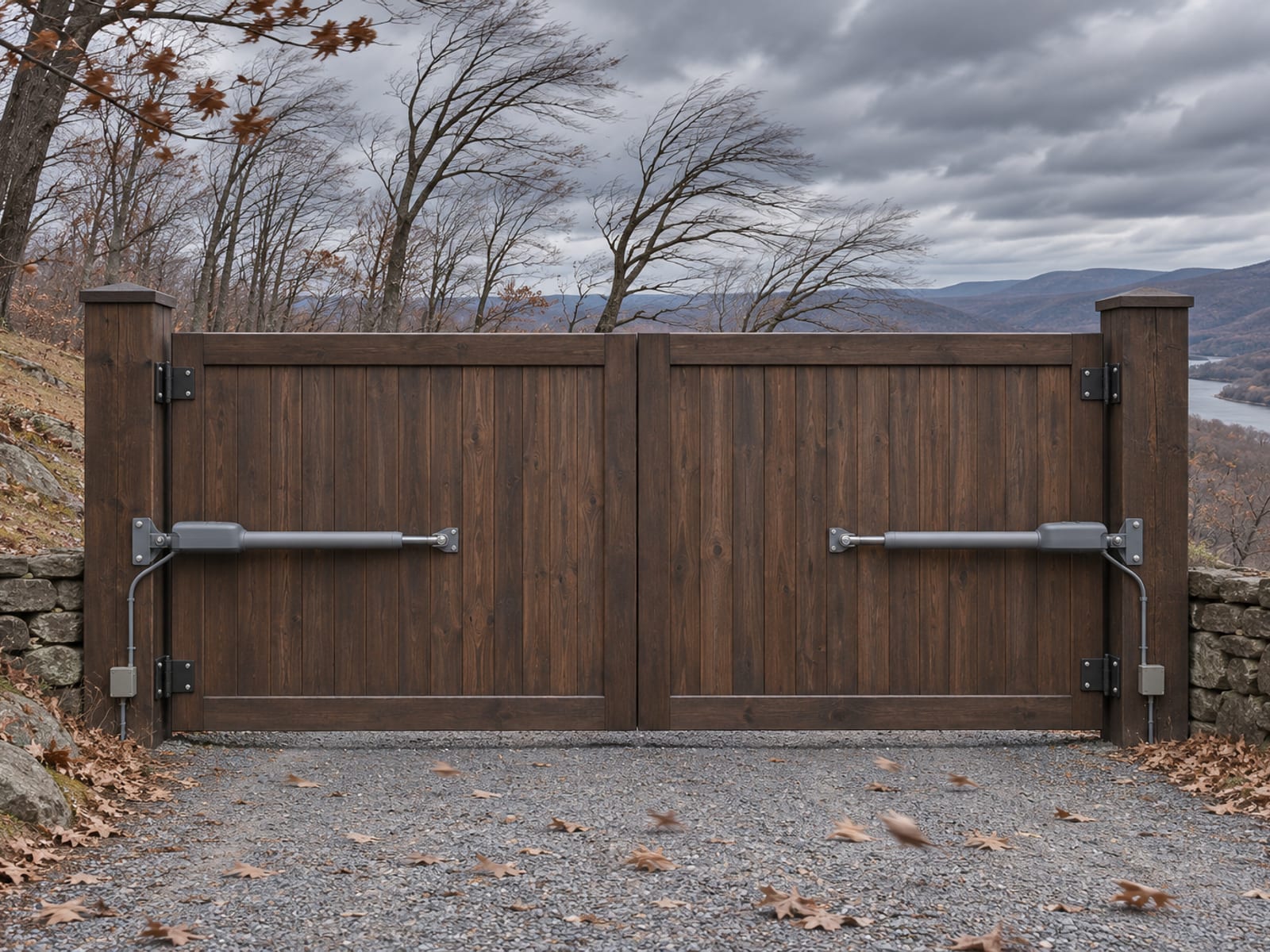
No maker publishes a simple table that turns a gate's surface area into an operator size, so the installer has to judge it on site. That judgment covers the gate's full dimensions, the infill, how exposed the driveway is, the mounting geometry, the hinge condition, the post strength and what happens if wind pushes on the gate while it stands open. On a hilltop lot in Putnam or Ulster County, that conversation matters more than on a sheltered village lot.
UL 325 Usage Classes and Entrapment Protection
UL 325 sorts vehicular operators into four classes by where they are used. Class I covers a home with one to four single-family dwellings and its garage or parking area. Class II covers commercial or general-access sites, including multifamily housing with five or more units, hotels, garages and stores. Class III covers industrial locations such as factories and loading docks, and Class IV covers guarded, restricted places such as airport security areas.
The class is not a weight rating. A Class I operator can be a strong one, and a Class II operator is simply labeled for that kind of site. UL 325 requires the operator to be labeled for its gate type and usage class, and the rules sit in Sections 26.11, 32.1 and 32.2 with Table 2 setting out the protection. The current listing from UL Standards & Engagement identifies UL 325 Edition 7, published May 19, 2017, with a revision dated September 15, 2025.
Table 2 matches each class to entrapment protection types. For Class I and II swing operators, primary protection is Type A (inherent sensing in the operator) or Type C (an adjustable clutch or pressure-relief device). For Class I and II slide operators, primary protection is Type A, with secondary protection from Type B1, B2 or D. The same device type cannot serve as both primary and secondary protection. The Intertek summary of Sections 26.11 and 32 and the Table 2 requirements document list the full set. For the residential side of this rule, see UL 325 Entrapment Protection for Residential Gates.
What Heavy Duty Operators Cost
Angi's 2026 guide to automatic gate installation gives national figures, not prices for the Hudson Valley. They cover the whole installation, so they sit above the cost of the operator alone, and a heavy solid gate with structural work, trenching or access control will land higher.
Angi's 2026 national automatic gate installation costs
---
Tap a row to open it.
Those figures come from Angi's automatic gate installation cost guide, read November 17, 2026. A quote for a heavy gate should name the operator model, the gate's weight and length, the safety devices, the electrical run, any access controls, and any track or post work. If a quote does not list these, ask for them in writing. What an Automatic Driveway Gate Costs breaks the price down further.
Lifespan and Maintenance
Makers publish warranties, duty ratings and maintenance schedules. They do not give a single service-life number in years, so the warranty is the clearest written commitment you will find. LiftMaster's CSW200UL carries a seven-year residential and five-year commercial operator warranty. Viking's X-9 carries three years residential and two years commercial. The SL585 carries two years. Details are on the CSW200UL product page and Viking's X-9 page.
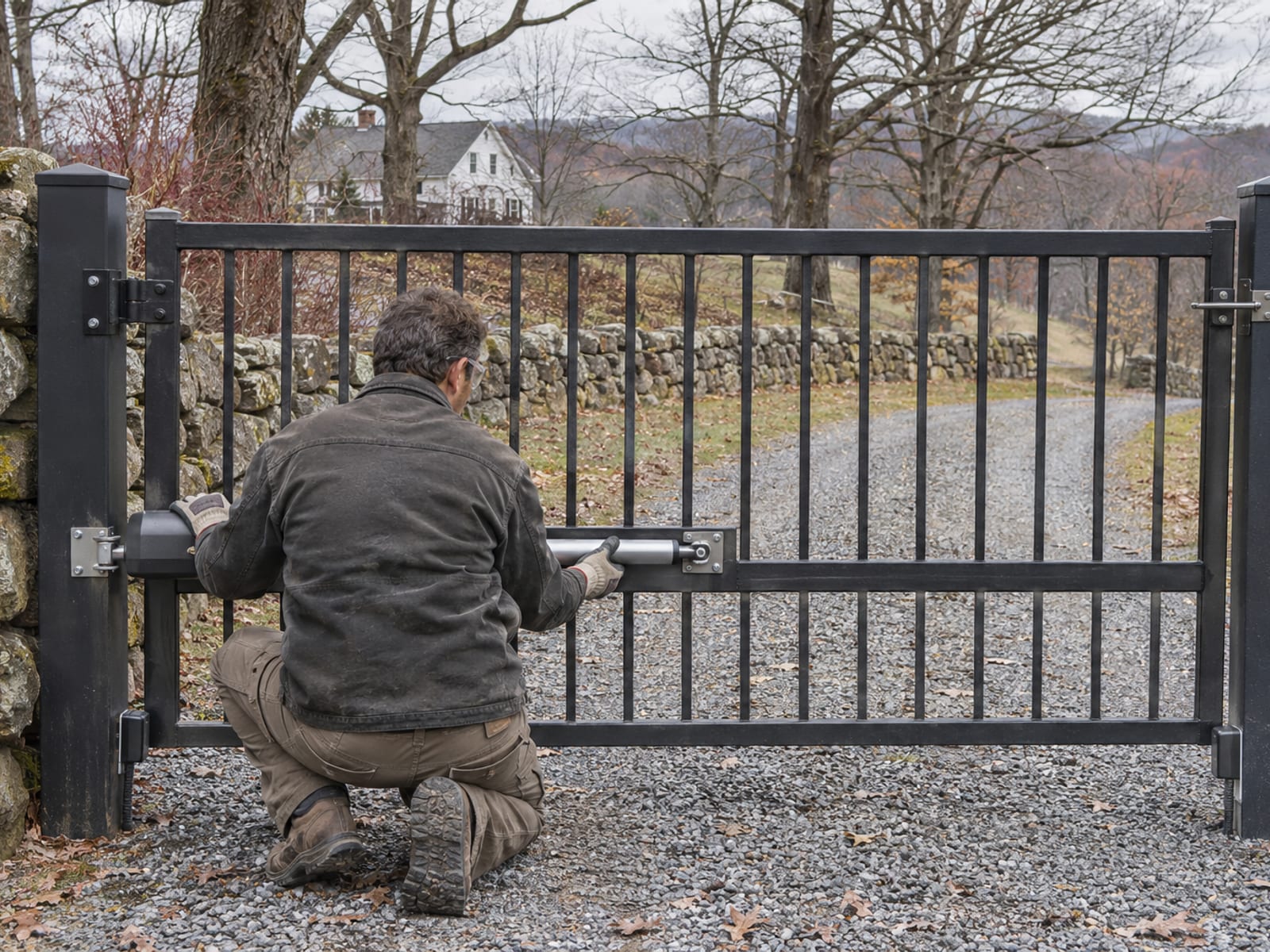
The CSW200UL installation manual also calls for inspecting the gate and operator, checking warning signs, and checking accessories and electrical connections, with more frequent maintenance for severe or high-cycle use. The LA500's drive system coating never needs lubrication, according to its product sheet, but that does not cover hinges, brackets, safety devices, wiring, batteries or mounting structure.
How long an operator lasts depends on the gate itself: its alignment, wind exposure, corrosion, hinge and track condition, mounting strength, cycle volume and how fast repairs happen. When you get a quote, ask for the warranty, the maintenance schedule and a condition check on the gate hardware. If your existing gate is already struggling, Why Your Automatic Gate Stopped Working covers the usual causes.
Frequently Asked Questions
How heavy a gate can a residential operator move?
It depends on the model and on the leaf length. The FAAC 415 is rated at 700 pounds per leaf up to 15 feet, and Viking's R-6 residential swing operator at 700 pounds up to 14 feet. Heavier gates move up to models such as the FAAC 400 at 1,300 pounds per leaf or the LiftMaster LA500, which varies from 1,600 pounds at 8 feet to 600 pounds at 18 feet.
Does UL 325 Class I mean the operator is weaker?
No. The class describes where the operator is used, not how much it can move. Class I is a home with one to four single-family dwellings, and Class II covers commercial and general-access sites. Weight and length limits are listed separately by each maker for each model.
Do I need a heavy duty operator for a solid gate?
Often, yes, if the gate is large or the lot is exposed to wind. FAAC USA points buyers to its hydraulic Model 400 when a gate is very heavy or wind is a determining factor. The installer should check the gate's exposed area, hinges, posts and foundation before choosing.
Is a longer gate harder on the operator even if the weight stays the same?
Yes. The LiftMaster LA500 drops from 1,600 pounds at 8 feet to 600 pounds at 18 feet, and Viking's G-5 drops from 2,000 pounds at 10 feet to 800 pounds at 18 feet. A longer leaf puts more load on the operator for the same weight.
How often should a heavy gate be tested?
LiftMaster's CSW200UL manual calls for monthly testing of entrapment protection, along with inspection of the gate, operator, signs and electrical connections. It says severe or high-cycle use needs more frequent maintenance.
Check yourself
1. What does a UL 325 usage class describe?
2. Which usage class covers a home with one to four single-family dwellings?
3. What does the LiftMaster LA500 rating table give for an 18-foot gate?
4. FAAC USA points buyers to which swing operator when a gate is very heavy or wind is a determining factor?
5. How often does LiftMaster's CSW200UL manual call for entrapment protection tests?
A heavy gate asks four things of an operator: weight at its real length, wind on its real surface, cycles per day, and a UL 325 label that fits the site. Check each against the maker's rating for the exact model, and have the quote spell out the safety devices and structural work. For a LiftMaster-specific walk-through, see the LiftMaster gate opener guide.
Portillo Fences and Gates serves Putnam, Westchester, Dutchess, Orange, Ulster and Rockland counties. Our automatic gates page lists the operator brands we work with, and gate repair covers existing automatic gates of any brand. To talk through your gate's size, use our contact page or call (845) 282-3336.