

October 2, 2026
- railings
- code
- outdoor steps
New York's residential code requires a handrail on at least one side of any flight of stairs with four or more risers, and that includes your front steps, stoop and deck stairs. A guard is a different rule: it is required once the walking surface sits more than 30 inches above the ground below. Count your risers and measure your drop before you call anyone.
Those two numbers decide most of what happens next. A three-step stoop that is 25 inches high may need nothing under the state code. A tall two-riser landing may need a guard. A five-step walkway to the front door needs a handrail even if the ground is close.
Orange County words its handrail trigger more strictly, at three risers. Aluminum and vinyl stand up best to freeze and thaw and road salt, steel needs its coating kept up, and a rail set into concrete, stone or brick costs more than one on sound wood framing.
Key Takeaways
Handrail trigger
A handrail is required on at least one side of each flight of stairs with four or more risers.
Guard trigger
A guard is required where a stair, landing or porch is more than 30 inches above the floor or grade below within 36 inches of the open edge.
Two different rules
A short stoop can need a guard for its height while a low five-step flight needs a handrail for its riser count.
Orange County
Its local law words the handrail trigger as three or more risers, so confirm the stricter rule with your building department.
Salt and freeze-thaw
Aluminum and vinyl have the lowest corrosion concern, coated steel and iron need coating upkeep, and wood needs the most.
Permits
A new handrail or guard on existing steps commonly needs a permit, and your town, village or city building department decides.
When Outdoor Steps Need a Handrail
The 2025 Residential Code of New York State, based on the 2024 ICC residential code and effective December 31, 2025, requires handrails on at least one side of each flight of stairs with four or more risers. The rule is in Section R318.7.8 of the residential code, and the 2024 text reads: "Handrails shall be provided on not less than one side of each flight of stairs with four or more risers." The Department of State's code FAQ confirms the adoption and the effective date.
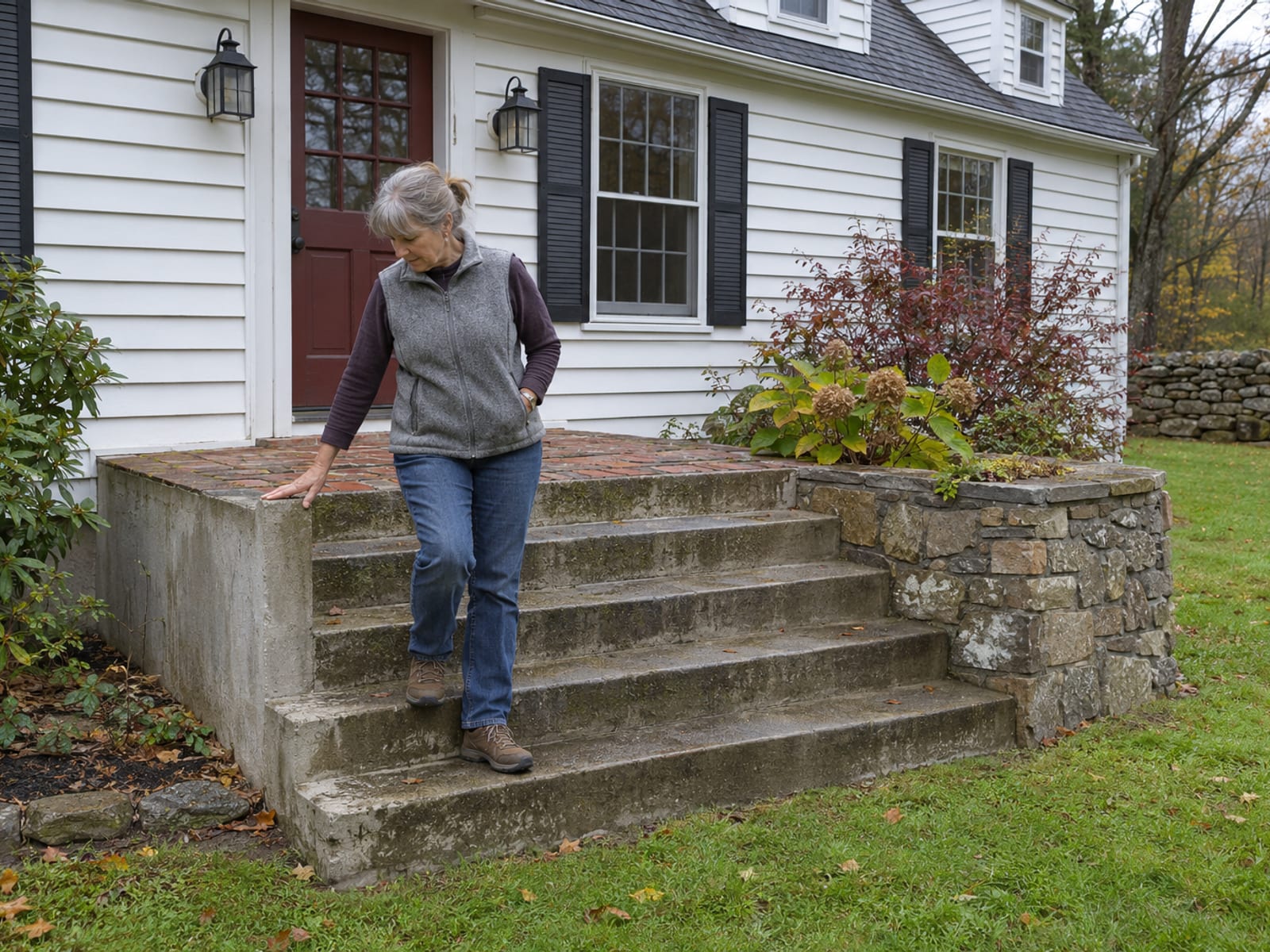
One side is the minimum for an ordinary one- or two-family stair. A second rail is a good idea for older family members, and the Dutchess County Office for the Aging recommends rails on both sides of stairs in its fall prevention checklist, but the state code does not demand it. A guard can serve as the handrail when its top sits at handrail height and can be gripped.
Handrail height is 34 to 38 inches, measured vertically from the sloped line that touches the tread nosings, under Section R320.2 in the 2024 text. Graspability and baluster spacing are covered in our guide to guard and handrail heights, so this post stays on the triggers, materials and cost.
The rule applies to a flight, not to a landing by itself. At an exterior door, Section R318.7.6 allows no top landing when the stairway has no more than two risers and the door does not swing over it. That exception covers the landing only. It does not remove the handrail or guard rules.
When Steps or a Landing Need a Guard
A guard protects against a fall off an open side. Under Section R321.1.1 of the 2025 residential code, guards are required along open-sided walking surfaces, including stairs, ramps and landings, that are more than 30 inches above the floor or grade below at any point within 36 inches horizontally of the open edge. The 2024 wording is: "Guards shall be provided for those portions of open-sided walking surfaces, including floors, stairs, ramps and landings that are located more than 30 inches measured vertically to the floor or grade below at any point within 36 inches horizontally to the edge of the open side."
The two triggers sit in different sections and answer different questions, which is why the numbers do not line up:
- Handrail: four or more risers, Section R318.7.8, one side minimum.
- Guard: more than 30 inches above grade within 36 inches of the open edge, Section R321.1.1.
Handrail rule and guard rule side by side
Trigger: ---
Code section: ---
Tap a row to open it.
A short stoop can therefore need a guard because of its height even with fewer than four risers. A long, low flight can need a handrail even though no guard is required. Required guards on porches, balconies and landings must be at least 36 inches tall under Section R321.1.2, and guards on the open sides of stairs can be 34 inches measured from the nosing line.
Permits and Stricter Local Rules
Orange County publishes a local law covering stairways, decks, porches and balconies. Section 7 of that document says handrails shall be provided on at least one side of each stairway with three or more risers, which is stricter than the state's four. It also calls for guards on porches and raised floor surfaces more than 30 inches above grade. If you live in Orange County, ask your building department which count applies to your address before you cut a single post.
The county does not run permits for you in most cases. Rockland County's contractor resources page sends residents to individual town and village building departments, and Dutchess County says permits are typically applied for at the local town building inspector's office. Putnam, Westchester and Ulster work the same way, town by town.
Under Section R105.1 of the residential code, a permit is required before work that must conform to the Uniform Code. Section R105.2 lets a locality exempt certain categories, but an exemption never excuses work that violates the code. Adding a required handrail or guard to existing steps touches a life-safety item and may involve anchoring into masonry, so a permit is commonly required. Your town, village or city building department gives the final answer, and a phone call before the job costs nothing.
Ask the department four things: whether a railing alone needs a permit, which riser count it applies, whether your steps count as part of an egress route, and whether a historic district or right-of-way rule changes the work. Ask for its current stair, deck and porch railing checklist while you are on the line.
Which Material Holds Up to Salt and Freeze-Thaw
Steps outside a Hudson Valley house take water, freezing nights, de-icing salt and sun. Each railing material handles that differently, and none of them is maintenance-free.
Aluminum does not rust the way steel does and generally needs less upkeep. A Massachusetts ironwork contractor, Mass Ironworks, calls aluminum systems non-rusting and suitable for porches and decks, though softer than iron and easier to dent. Excell Railing Systems describes its powder-coated aluminum finish as resistant to UV and saltwater exposure.
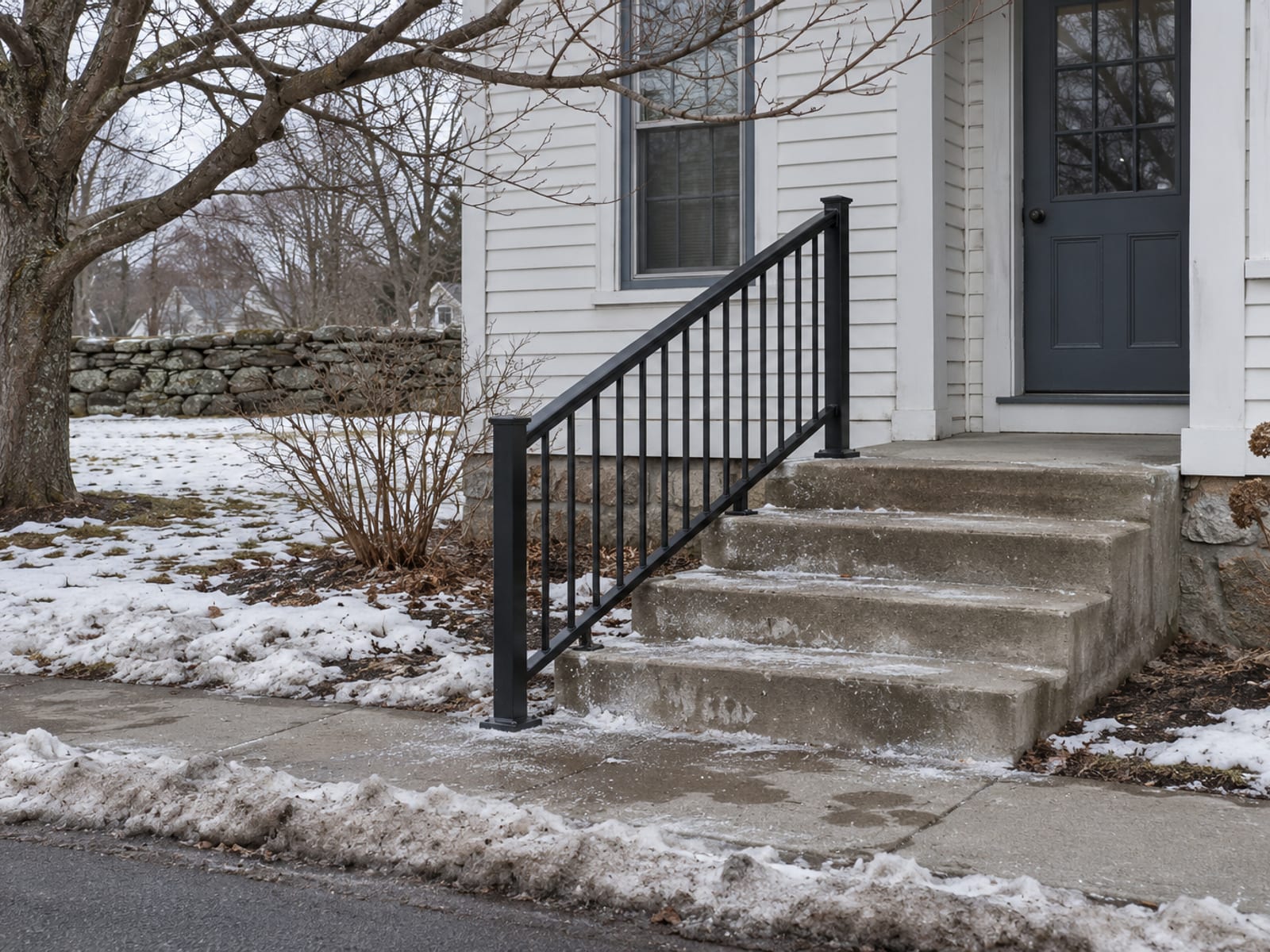
Galvanized steel carries a zinc coating over the steel. HomeGuide describes it as suitable for interior and exterior use, and properly coated wrought iron as durable outdoors. Powder coating is a finish, not armor. Fairway Architectural Railing Solutions excludes normal weathering, scratching and corrosive contaminants from its warranty and ties coverage to a cleaning schedule based on AAMA 609.1. A chip that exposes bare steel should be touched up before rust spreads under the finish. Our galvanizing page covers hot-dip protection for steel gates and railings.
Vinyl does not rust or rot. Weatherables states that its vinyl has titanium dioxide in the outer layer for UV protection and impact modifiers for cold weather, and that vinyl gets less flexible in the cold. Vinyl posts and rails need the manufacturer's reinforcement and attachment system, so a cheap kit bolted to a wobbly step stays wobbly.
Wood has the highest upkeep. The U.S. Forest Service Forest Products Laboratory documents salt damage in wood exposed to de-icing salt: salt water wicks in, and repeated wetting and drying lets salt crystals separate the surface fibers. A Florida DOT maintenance manual calls moisture the primary enemy of wood and recommends treating checks and splits promptly.
For materials on porches and decks rather than steps, see porch railings in vinyl, aluminum or steel. For the steel work Portillo fabricates, see custom steel railings.
How a Railing Is Anchored Into Concrete, Stone or Brick
The mounting method matters as much as the material, because frozen water is what breaks a rail loose. There are three common methods.
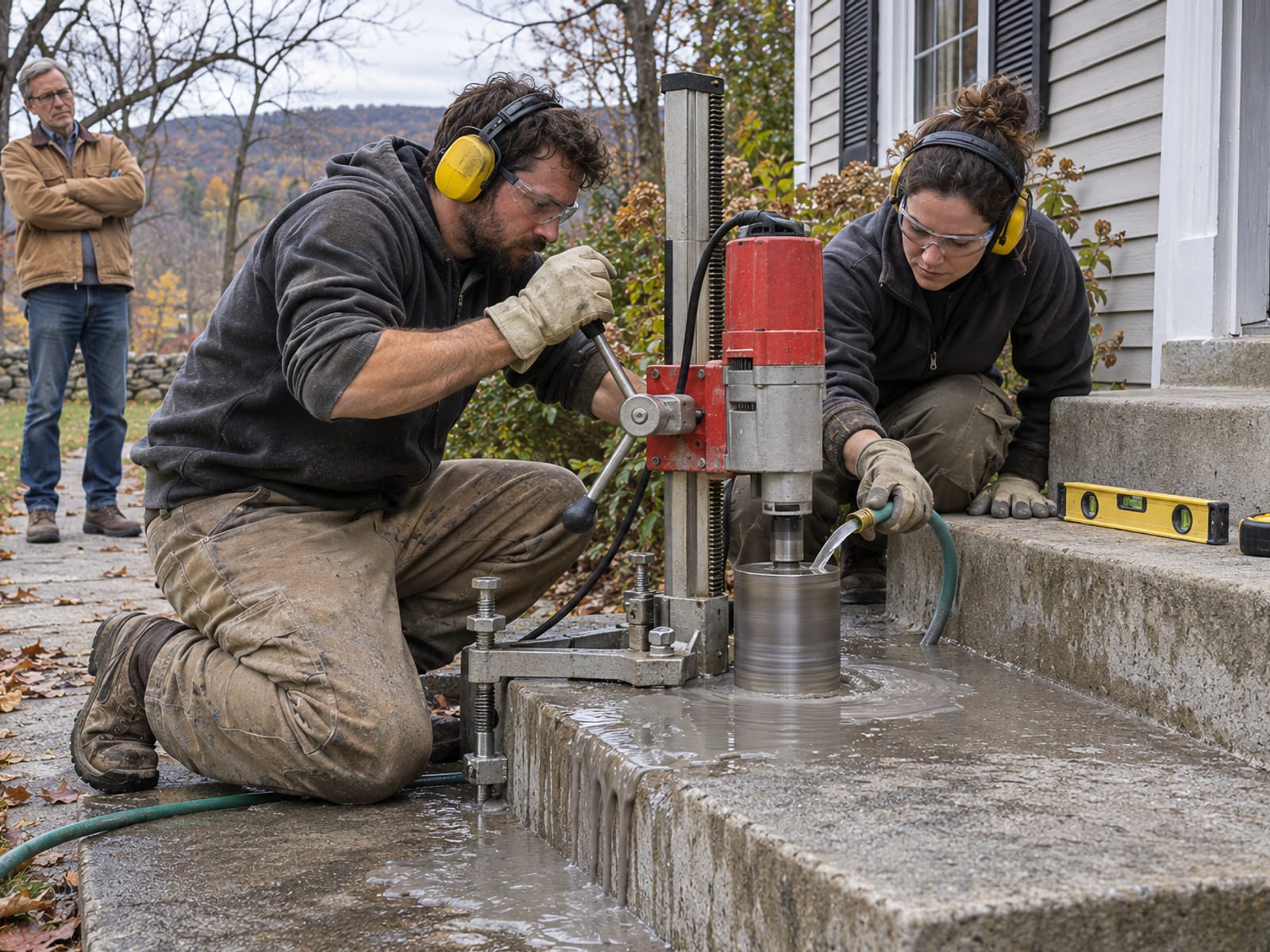
Core drilling cuts a sleeve into the concrete or masonry for the post. A public specification from New Hampshire State Parks calls for core-drilled holes, three 1/4-inch by 3.75-inch stainless pins per post to resist frost movement, and nonshrink grout tapered away from the post so water runs off. The same specification requires weep holes in hollow sections. An ARCAT cable railing specification calls for a way to drain water from hollow exterior members and core holes at least 5 inches deep and 3/4 inch larger than the post.
Surface mounting bolts a base plate to the top of the step with mechanical or adhesive anchors. It suits steps with enough top width and avoids a deep sleeve, but the anchors sit in standing water, salt and freeze-thaw movement. Edge distance, slab thickness and the condition of the concrete decide whether the anchors hold. Sealant slows water entry, but it does not replace sound concrete or correct anchor depth.
Side mounting fastens posts to the vertical face of a step, curb or retaining wall. It keeps the tread width clear and avoids drilling near the front edge. It needs a thick, solid face. Brick veneer, hollow block, crumbling stone and thin nosings may need structural backing or through-bolting.
Whatever the method, aluminum should be kept apart from cement and lime mortar to prevent electrolytic action, fasteners should be stainless or otherwise rated for exterior use, and hollow posts should drain.
What a Step Railing Costs Installed
Published figures vary by material, region and job size, so each one below carries its own source and region. Portillo's own quote depends on your run length, the step material and the finish.
Installed outdoor railing cost figures by source
Item: ---
Published figure: ---
Tap a row to open it.
The Massachusetts and Northeast figures are the closest to Hudson Valley work. Mass Ironworks describes custom iron and steel with powder coating, removal of old railings and masonry anchoring in those prices, and PMFII Iron Work USA publishes the Northeast ranges. The national numbers come from HomeGuide's stair railing cost and outdoor handrail cost pages. HomeGuide also allows $50 to $300 for a permit and inspection, depending on the municipality.
That last point explains many quote gaps. Anchoring into concrete, stone or brick costs more than fastening to sound wood framing, and removing an old rail adds labor. When you compare two quotes, check that both cover the same run, the same finish and the same anchoring.
For scheduling, ask for separate dates for the site measurement, shop drawing approval, fabrication, permit review and installation. Steel work is made to your measurements, so the permit and fabrication steps can overlap if the plan is settled early.
Frequently Asked Questions
Do three outdoor steps need a handrail in New York?
Under the state residential code, a handrail is required on at least one side of a flight with four or more risers (2025 RCNYS Section R318.7.8). A three-riser flight falls below that number. Orange County's local law words its trigger as three or more risers, so confirm with your building department.
Do I need a railing on both sides of my steps?
The state code requires one side at minimum for an ordinary one- or two-family stair. A rail on both sides is easier for children and older adults, and the Dutchess County Office for the Aging recommends both sides in its fall prevention checklist.
How high does my porch or landing have to be before it needs a guard?
A guard is required where the walking surface is more than 30 inches above the floor or grade below within 36 inches horizontally of the open edge (Section R321.1.1). Required guards on porches, balconies and landings must be at least 36 inches high under Section R321.1.2.
Does adding a railing to existing steps need a permit?
It commonly does, because a required handrail or guard is a life-safety item and may be anchored into masonry. The exact answer comes from your town, village or city building department, so call before the work starts.
Which railing material lasts longest where roads are salted?
Aluminum and vinyl have the lowest corrosion concern. Galvanized or powder-coated steel and wrought iron look the most traditional but need coating upkeep. Wood is the most vulnerable to salt damage and needs regular finish work.
Check yourself
1. At how many risers does the New York residential code require a handrail on a flight of stairs?
2. How far above the floor or grade below must a walking surface be before a guard is required?
3. What is the minimum handrail height range under Section R320.2?
4. Which material does the U.S. Forest Service document as suffering salt damage from de-icing salt?
5. What should you do about aluminum posts set into cement or mortar?
Count your risers, measure the drop from the top surface to the ground, and call your building department about the permit before you buy a rail. If the steps are concrete, stone or brick, plan the anchoring first, because it drives both the cost and how long the rail lasts.
For a measured quote on railings for steps, stoops and decks, contact Portillo Fences and Gates, see our railing installation and steel railings pages, and reach us through the contact page for Putnam, Westchester, Dutchess, Orange, Ulster and Rockland counties, or call (845) 282-3336.