

November 17, 2026
- solar gate opener
- automatic gates
- winter
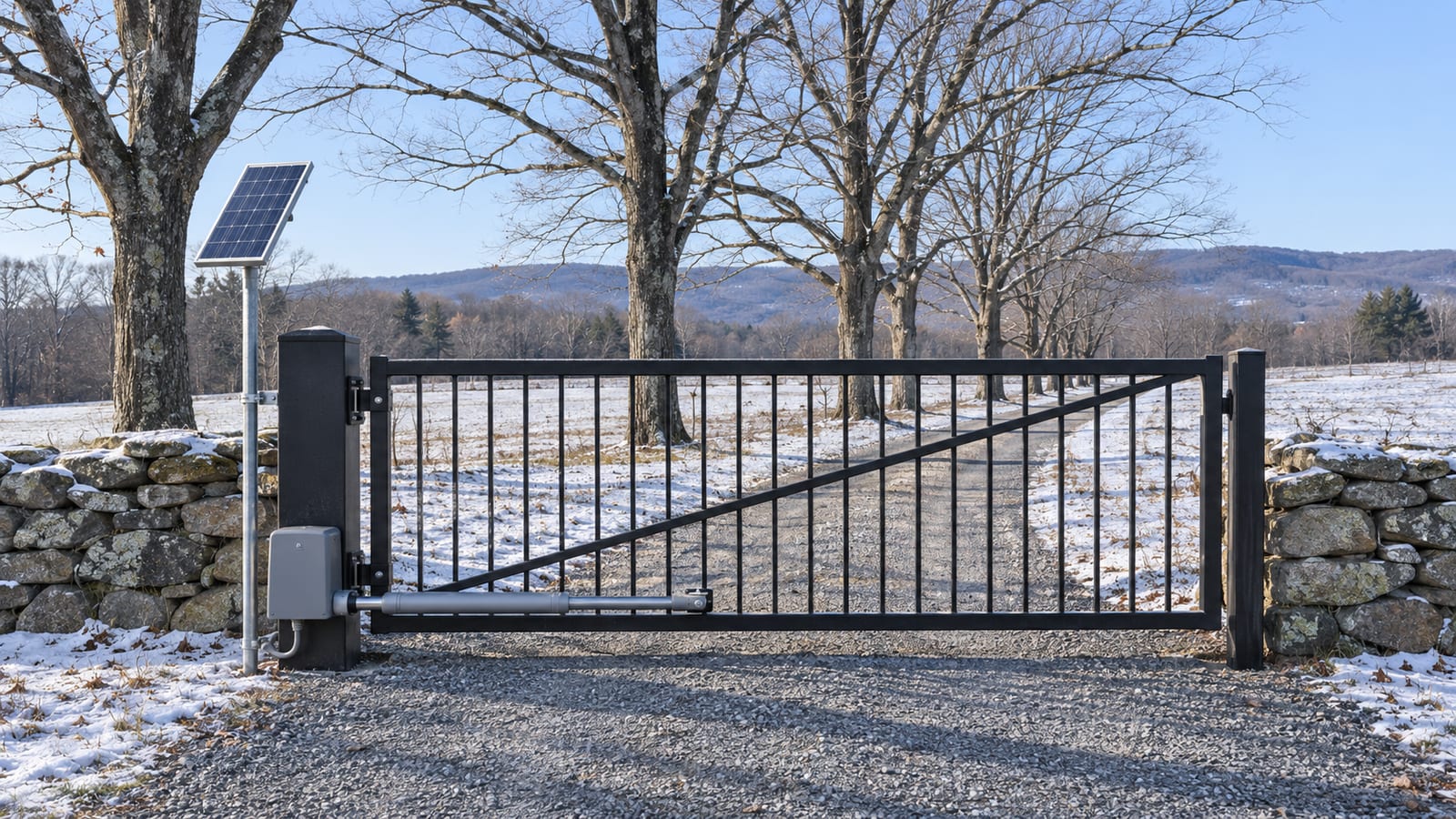
A solar gate opener in the Hudson Valley gets its least sun in December, about 2.28 peak sun hours a day near Poughkeepsie, compared with 3.92 for the year. The opener still runs on its battery, but the panel has far less to put back each day. Whether that is enough depends on how often the gate cycles, how big the panel and battery are, and whether snow and shade reach the panel.
If your gate sits a long way from power, solar can be the right call. If an outlet is within the maker's wire limit, a plug-in charger is usually simpler. The sections below give the figures from the makers and from NREL so you can size a system, or decide against one, before you buy.
If you already own a solar opener that dies in December, the cold-battery and panel-placement sections will show you what to check first.
Key Takeaways
December sun
Near Poughkeepsie, NREL PVWatts data shows 2.28 kWh/m²/day in December and 3.02 in January, well under the 3.92 yearly average.
Panel size
LiftMaster, Mighty Mule and Viking Access publish very different panel sizes, so you must match the exact operator model rather than a generic chart.
Cold batteries
LiftMaster says cycles and standby time can drop by at least 50% when temperatures stay below -4°F for more than two weeks.
No heaters on solar
LiftMaster, GTO and DoorKing all say their battery heaters work only with AC-powered operators.
Panel placement
A low winter sun means a panel that is clear of shade in July can sit in shadow in January.
AC charging
A plug-in charger is often the simpler choice when the low-voltage run stays inside the maker's distance limit.
How Much Winter Sun the Hudson Valley Gets
NREL PVWatts data for a New Paltz project, using the Poughkeepsie Dutchess County Airport weather station, shows 3.02 kWh/m²/day in January and 2.28 in December. The yearly average is 3.92, for a fixed array facing south and tilted 20 degrees. The figures come from the SUNY New Paltz Final Energy Master Plan, and NREL's PVWatts documentation explains how they are calculated.
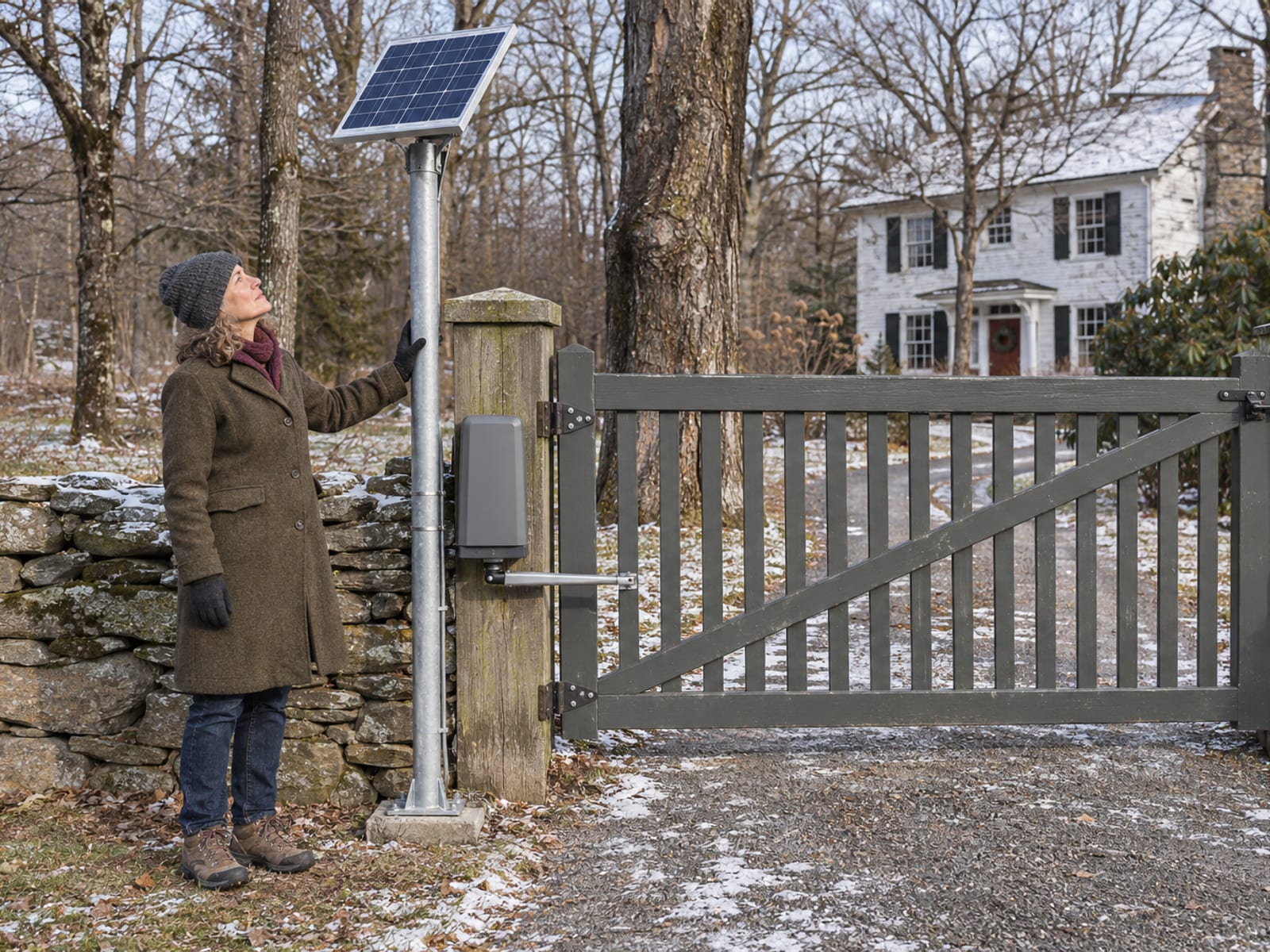
Read the number as an energy budget, not a promise. A 2.28 reading means the panel gets about as much energy as 2.28 hours of full-strength sun, before losses in the wiring, controller and battery. NOAA's 1991 to 2020 Poughkeepsie normals put the average January temperature at 27.1°F and December at 32.1°F, so the panel is also working while the battery is cold.
LiftMaster sorts sites into three solar zones in its LA400 installation manual: Zone 1 is six hours of sunlight a day, Zone 2 is four, and Zone 3 is two. A Hudson Valley December falls near the Zone 3 line and the yearly average near Zone 2. The manual's zones count hours of sunlight and PVWatts counts peak-sun equivalents, so treat that comparison as a rough guide. For a final answer, ask for an address-level PVWatts run once you know where the panel will go.
What the Makers Say Panels and Batteries Need
Each maker sizes solar differently, and the figures do not transfer from one brand to another. A 20-watt Mighty Mule chart, a 20-watt LiftMaster chart and an 80-watt Viking chart describe different motors, batteries, control boards and gate loads. The table below pulls the published numbers side by side so you can see how wide the range is.
Published solar panel and battery figures by maker
Panel: ---
Battery: ---
Published cycle figure: ---
Tap a row to open it.
The figures come from the LA400 manual, the RSL12U manual, the Mighty Mule planning guide, the Viking R6 manual and Ghost Controls' battery page.
The Viking figure is the one to look at for winter. Its January map gives roughly 2 to 14 cycles a day depending on location, and it assumes an 80-watt panel, a single operator, one radio receiver, one loop detector and one photo beam. Mighty Mule's guide lists dual gates at lower cycle counts than single gates, and says dual gates need at least 10 watts. Ghost Controls says cycle capacity depends on the operator, gate load, accessories, battery condition and available solar, which is why it publishes no single table. Our posts on Mighty Mule opener problems and Ghost Controls opener repair cover those two brands in more detail.
Cold, Snow and Shade Take Their Share
Cold cuts what a battery can deliver. LiftMaster lists temperatures below 32°F, snow-covered panels and shorter winter days as the conditions that hurt solar gates. Its solar cycles reference guide says daily cycles and standby time can fall by at least 50% when temperatures stay below -4°F for more than two weeks. For the 7Ah battery in the RSL12U, LiftMaster recommends the 33Ah cold-weather battery when temperatures stay under 32°F for more than two weeks along with snow or short days.
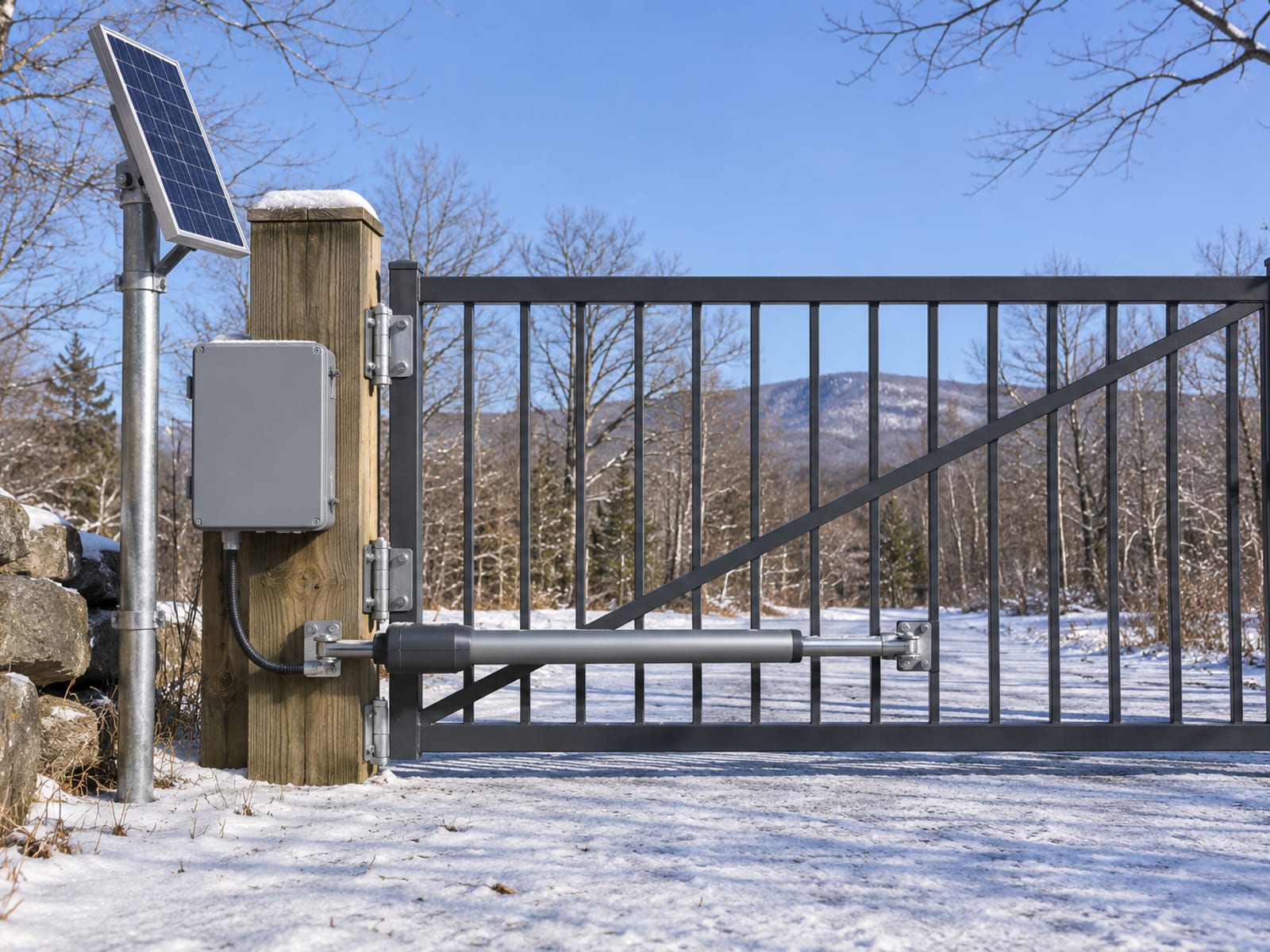
Tilt and snow go together. A steeper panel sheds snow and ice faster and catches the low winter sun better. LiftMaster recommends adding 15 degrees of tilt in regions near Canada, for about 60 degrees total, and a general solar-operator manual suggests 45 degrees facing south, noting that the best angle varies. Whichever you choose, clear snow and ice off the panel by hand, because a covered panel charges little or nothing.
Shade is the quiet problem. LiftMaster notes that trees or buildings that leave a panel alone in summer can shade it in winter, because the sun rides lower. It wants a clear east-to-west view across the sun's path with no all-day obstruction. In practice, a panel bolted next to the operator can do worse than the same panel moved to a sunnier post or pole, even when both spots get full summer sun. The maker manuals allow that move: Ghost Controls permits up to 100 feet of 16-gauge wire between panel and control box, and one Mighty Mule installation manual recommends up to 250 feet for relocating a panel in one configuration.
Battery Heaters Do Not Work With Solar
The usual cold-weather fix, a battery heater, is not available on a solar setup. LiftMaster's RSL12U manual says a heater cannot be used with a solar application. The GTO BH-1 heater manual says its thermostat switches on below 40°F, needs transformer power and will not work on solar. DoorKing says its 6524 heater kit is required below freezing but works only with AC-powered operators.
One Viking product specification lists an integrated heater and an operating range down to -20°F. The Viking 80-watt solar manual does not say that every Viking solar configuration includes or allows that heater, so ask for the exact model before you count on it.
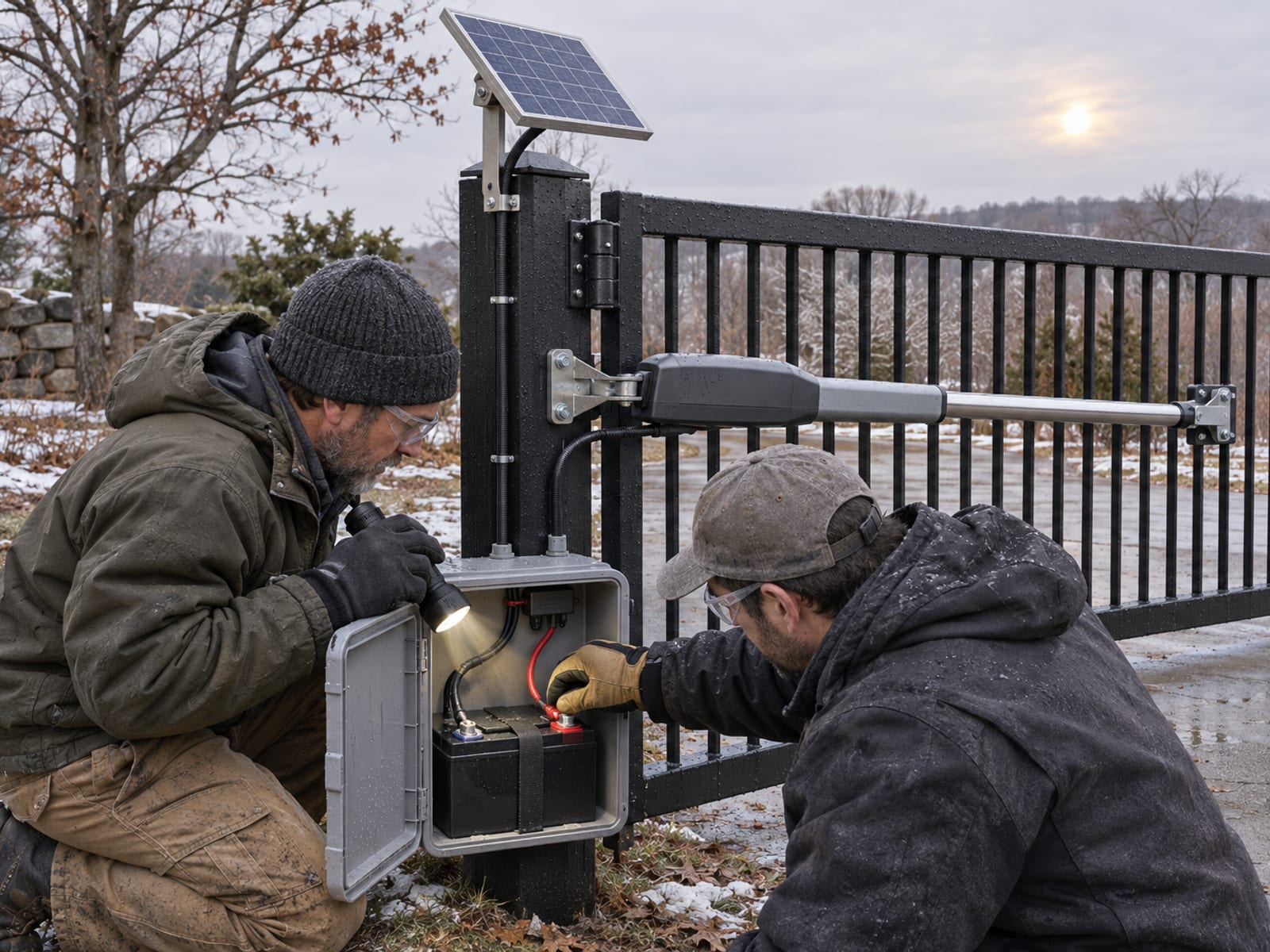
That leaves the battery itself. LiftMaster's RSL12U manual recommends replacement every three years because batteries wear with temperature and use. A separate CM3-DC manual suggests three to four years. If your solar opener gets slow or quits by January, a tired battery is the first thing to test, and our post on why an automatic gate stops working lists the other causes in the order to check them. Our automatic gate winter problems post covers ice, frozen tracks and other cold-weather faults that have nothing to do with power.
When an AC Charger or a Buried Line Is the Better Answer
An AC transformer is a battery charger, not the motor's power source. Ghost Controls says its 12-volt battery stays the primary power source and is recharged by either the transformer or solar panels, and it says not to run solar panels and a transformer on the same system. The transformer can sit up to 1,000 feet from the operator on 16-gauge or larger stranded two-conductor low-voltage wire, and Ghost Controls tells you to stay under 1,000 feet because of losses. Its DD2U manual holds the details.
Mighty Mule also uses 16-gauge UV-resistant direct-burial wire and says not to run more than 1,000 feet. So, if an outlet sits within that range, a plug-in charger takes the December sun problem off the table. Solar makes more sense when the gate is beyond the wire limit, when trenching would cross finished pavement or hard ground, or when no practical outlet exists.
Trenching is what makes a long driveway expensive. Two Texas installers publish trenching and power-run prices, each listed with its region:
Published trenching and power prices, Texas installers
Item: ---
Published price: ---
Tap a row to open it.
Garland Gate Pros says a 300-foot driveway can make bringing power to the gate cost more than the operator itself. Texas prices are not Hudson Valley prices, so ask any installer here to split the quote into trenching, conduit, wire, the electrical connection, restoration and any permit or inspection charge. Our post on what an automatic driveway gate costs shows how those items fit into the whole job.
Buried power also makes sense when you want dependable winter charging and a heater, or lights and an intercom, and the trench is already open for another project. LiftMaster's guide to its own openers covers how its AC models differ from the solar ones.
Sizing a Solar System Before You Buy
Start with the gate. A heavier or longer leaf, more accessories and more daily trips all raise the energy a day takes. LiftMaster's reference guide says panel wattage, gate type, daily cycles, accessories and regional sunlight set the panel count, so count your real trips. Every open and close is a cycle, and every guest or delivery adds more.
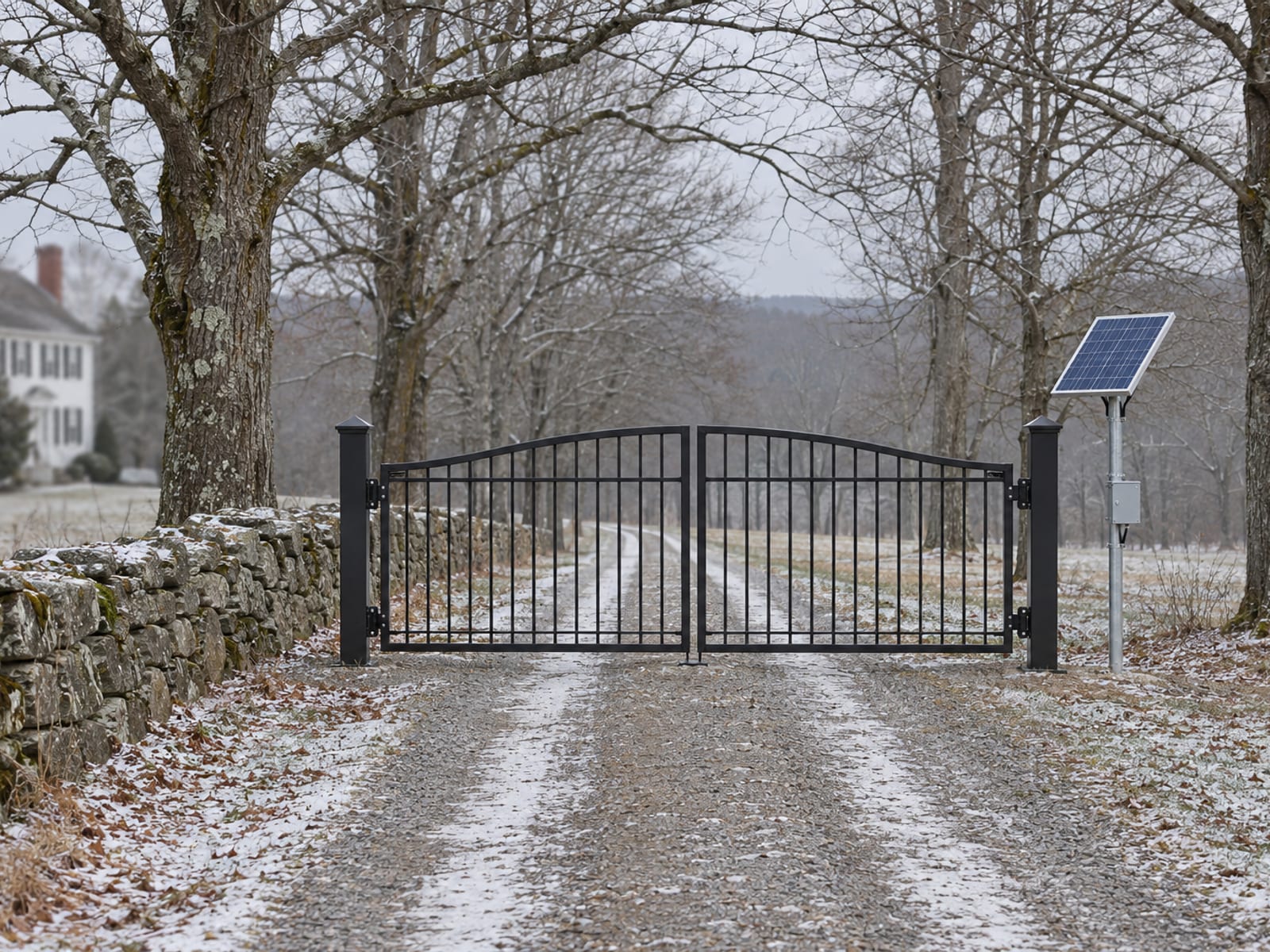
Then pick the panel spot before the panel size. Look at where the sun lands at noon in December, not June, and count any trees or roof lines that cut across it. Choose the larger battery option if the maker offers a cold-weather one. If your count of daily cycles looks high against the table above, add watts or choose a different power source. Matching the exact operator model matters more than any chart.
If you want a second opinion on an existing gate, our gate repair team looks at automatic gates of any brand. For a new automatic gate, the automatic gates page lays out the operators we install. The swing or slide driveway gate post helps if you are still choosing a gate type.
Frequently Asked Questions
How many sun hours does a solar gate opener get in a Hudson Valley winter?
NREL PVWatts data for the Poughkeepsie airport station shows 3.02 kWh/m²/day in January and 2.28 in December, against a 3.92 yearly average. That is the energy reaching a south-facing panel tilted 20 degrees, before wiring, battery, snow and shade losses.
What size solar panel does a gate opener need?
It depends on the maker. LiftMaster's LA400 needs at least two 10-watt panels and allows six, Ghost Controls allows up to three 10-watt panels, Mighty Mule lists 10 to 30 watts, and Viking's R6 calls for at least an 80-watt, 24-volt system. Match the number to your exact operator and gate.
Can I put a battery heater on a solar opener?
LiftMaster, GTO and DoorKing all say their heaters work only on AC-powered operators. If winter cold is the main worry, that points toward an AC charger or a 33Ah cold-weather battery where the maker offers one.
How often should the battery be replaced?
LiftMaster's RSL12U manual recommends every three years, and a separate CM3-DC manual says three to four. Cold, deep discharge and heavy use all shorten the life.
How far can a plug-in charger sit from the gate?
Ghost Controls allows its transformer up to 1,000 feet away on 16-gauge or larger stranded two-conductor wire, and Mighty Mule also says not to exceed 1,000 feet. Other makers and 110-volt systems use different tables, so check yours.
Can I run solar and an AC transformer together?
Ghost Controls says not to use solar panels and an AC transformer on the same system at the same time. Pick one charging source.
Check yourself
1. What does NREL PVWatts data for the Poughkeepsie station show for December?
2. What do LiftMaster, GTO and DoorKing say about battery heaters on solar openers?
3. How far can a Ghost Controls AC transformer sit from the operator?
4. How often does LiftMaster's RSL12U manual recommend replacing the battery?
5. Why can a panel that works in summer fail in winter?
A solar opener can work in a Hudson Valley winter if the panel gets a clear view of the low sun, the battery is sized for the cold and the gate does not cycle more than the system can replace. When the gate is close to an outlet, a plug-in charger removes the winter question, and a long driveway is where trenching and solar have to be weighed against each other.
If your solar opener struggles in January, or you are deciding how to power a new one, talk to Portillo Fences and Gates about gate repair or automatic gates across Putnam, Westchester, Dutchess, Orange, Ulster and Rockland counties. Use our contact page or call (845) 282-3336.